
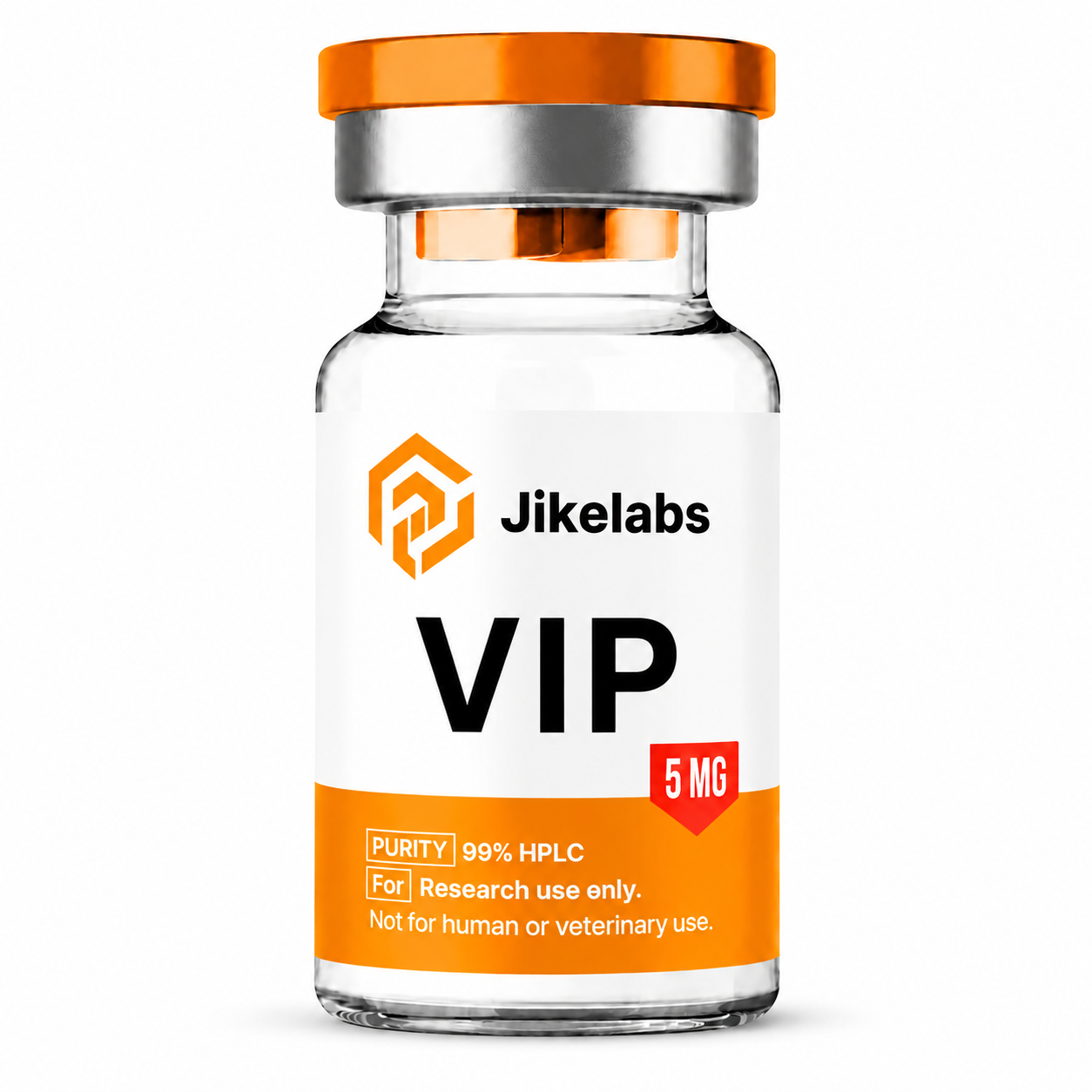
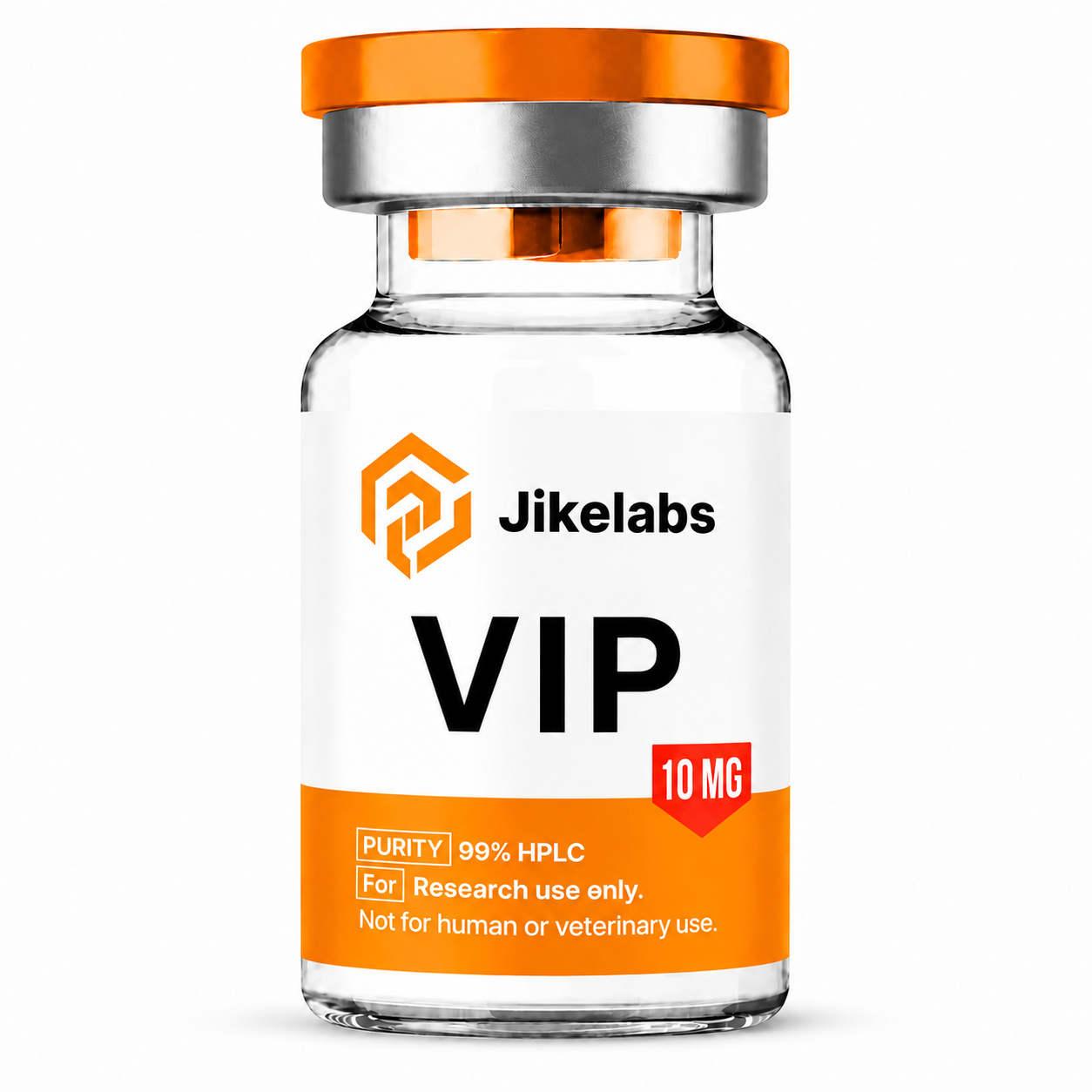
Vasoactive Intestinal Peptide (VIP) 5MG 10MG
-
Detail
Research Peptide · For Laboratory Use Only
Vasoactive Intestinal Peptide (VIP) 10mg
VIP (1–28) · 28-Amino-Acid Neuropeptide · C-Terminally Amidated · Lyophilized Powder · Purity ≥99% (HPLC)
Vasoactive Intestinal Peptide (VIP) is a 28-amino-acid neuropeptide first isolated from intestinal tissue. Widely distributed throughout both the central and peripheral nervous system, VIP functions as a neurotransmitter, neuromodulator and circulating hormone with remarkably broad biological activity — from vasodilation and smooth muscle relaxation to immune regulation and circadian rhythm control.
The amino acid sequence of VIP is identical in human, porcine, bovine and rat species, which makes it a highly conserved and reproducible research compound. Each vial is supplied as a sterile lyophilized (freeze-dried) powder to ensure maximum stability.
Product Specifications
Product Name Vasoactive Intestinal Peptide (VIP, VIP 1–28) CAS Number 37221-79-7 Amino Acid Sequence His-Ser-Asp-Ala-Val-Phe-Thr-Asp-Asn-Tyr-Thr-Arg-Leu-Arg-Lys-Gln-Met-Ala-Val-Lys-Lys-Tyr-Leu-Asn-Ser-NH₂ (single-letter: HSDAVFTDNYTRLRKQMAVKKYLNSLN-NH₂, 28 residues, C-terminally amidated) Molecular Formula C₁₄₇H₂₃₇N₄₃O₄₃S Molecular Weight 3326.8 g/mol Species Human (sequence identical in porcine, bovine and rat) Quantity 10mg per vial Physical Form White to off-white lyophilized powder Purity ≥98% as determined by HPLC Storage -20°C for long term; 2–8°C for short term (lyophilized) What is Vasoactive Intestinal Peptide?
VIP belongs to the secretin/glucagon peptide superfamily, which also includes PACAP, secretin, GIP and glucagon. It was originally discovered for its ability to cause vasodilation and lower arterial blood pressure, but decades of research have revealed a much broader functional profile.
VIP is produced by neurons throughout the central and peripheral nervous system and acts through two G-protein-coupled receptors, VPAC1 and VPAC2. Because these receptors are expressed in blood vessels, smooth muscle, immune cells, endocrine organs and the brain, VIP participates in a remarkably wide spectrum of physiological processes:
- Cardiovascular: vasodilation and blood pressure regulation;
- Gastrointestinal: smooth muscle relaxation, intestinal secretion and motility regulation;
- Neuroendocrine: regulation of circadian rhythms in the suprachiasmatic nucleus, and prolactin/growth hormone axis modulation;
- Respiratory: bronchodilation and airway smooth muscle tone;
- Immune: immunomodulatory and anti-inflammatory actions on macrophages and T cells.
The breadth of VIP's activity has made it one of the most intensively studied neuropeptides in physiology, with ongoing research spanning neurobiology, gastroenterology, immunology and reproductive biology. Its pleiotropic (multi-functional) character is precisely what keeps VIP at the center of peptide research.
Mechanism of Action
Handling & Storage Guidelines
- Lyophilized powder: Store at -20°C for long-term stability; 2–8°C is acceptable for short-term storage. Avoid repeated temperature cycling and protect from light.
- Before opening: Allow the vial to reach room temperature and briefly centrifuge to ensure the full contents collect at the bottom of the vial.
- Reconstitution: VIP is readily soluble in water, physiological saline and pH 7.0–8.0 buffers. Add solvent gently along the vial wall and swirl slowly until fully dissolved; avoid vigorous shaking. Note that VIP is prone to enzymatic degradation and surface adsorption in dilute solution — carrier proteins or appropriate buffers are commonly used in experimental settings.
- Reconstituted solution: Store at 2–8°C and use promptly; aliquot if needed and avoid repeated freeze-thaw cycles.
- General: Handle with standard laboratory protective equipment (gloves, lab coat, eye protection).
Why Choose Our VIP?
🧪
Verified Purity
Each batch tested by HPLC & MS; COA available upon request.
📦
Secure Packaging
Sealed vials with temperature-protective packaging for safe delivery.
🚚
Fast Dispatch
Orders processed promptly with tracking provided.
Frequently Asked Questions
Q1: What is the difference between VIP and PACAP?
A: VIP and PACAP (pituitary adenylate cyclase-activating polypeptide) are closely related members of the same peptide superfamily and share receptor overlap (VPAC1/VPAC2), but they are distinct peptides with different sequences, tissue distributions and primary research applications. PACAP also binds the PAC1 receptor.
Q2: Does the species source matter for VIP research?
A: The amino acid sequence of VIP is identical in human, pig, cattle and rat, so synthetic VIP is fully applicable across these species. This high conservation is one reason VIP is such a versatile research compound.
Q3: How should I store it after receiving?
A: Keep unopened vials at -20°C for long-term storage. Once reconstituted, refrigerate at 2–8°C and use promptly; aliquot and avoid repeated freeze-thaw cycles. Because VIP degrades readily in solution, plan reconstitution volumes around immediate use.
Q4: Is a Certificate of Analysis (COA) available?
A: Yes, third-party tested COA documentation can be provided for each batch. Please contact our customer service with your order number.
⚠ Research Use Only — Disclaimer
All product information provided on this page is solely for information dissemination and educational purposes. The products offered are intended exclusively for in vitro laboratory research and are not pharmaceuticals. They have not been approved by the U.S. Food and Drug Administration (FDA) or any other regulatory authority for the purposes sold here, and must not be used to prevent, treat or cure any medical condition, disease or ailment.
It is strictly prohibited to introduce these products into the human or animal body in any form. By purchasing, the buyer acknowledges full responsibility for the proper handling, use and compliance with all applicable local laws and regulations.
-
Customer ReviewsNo comments