
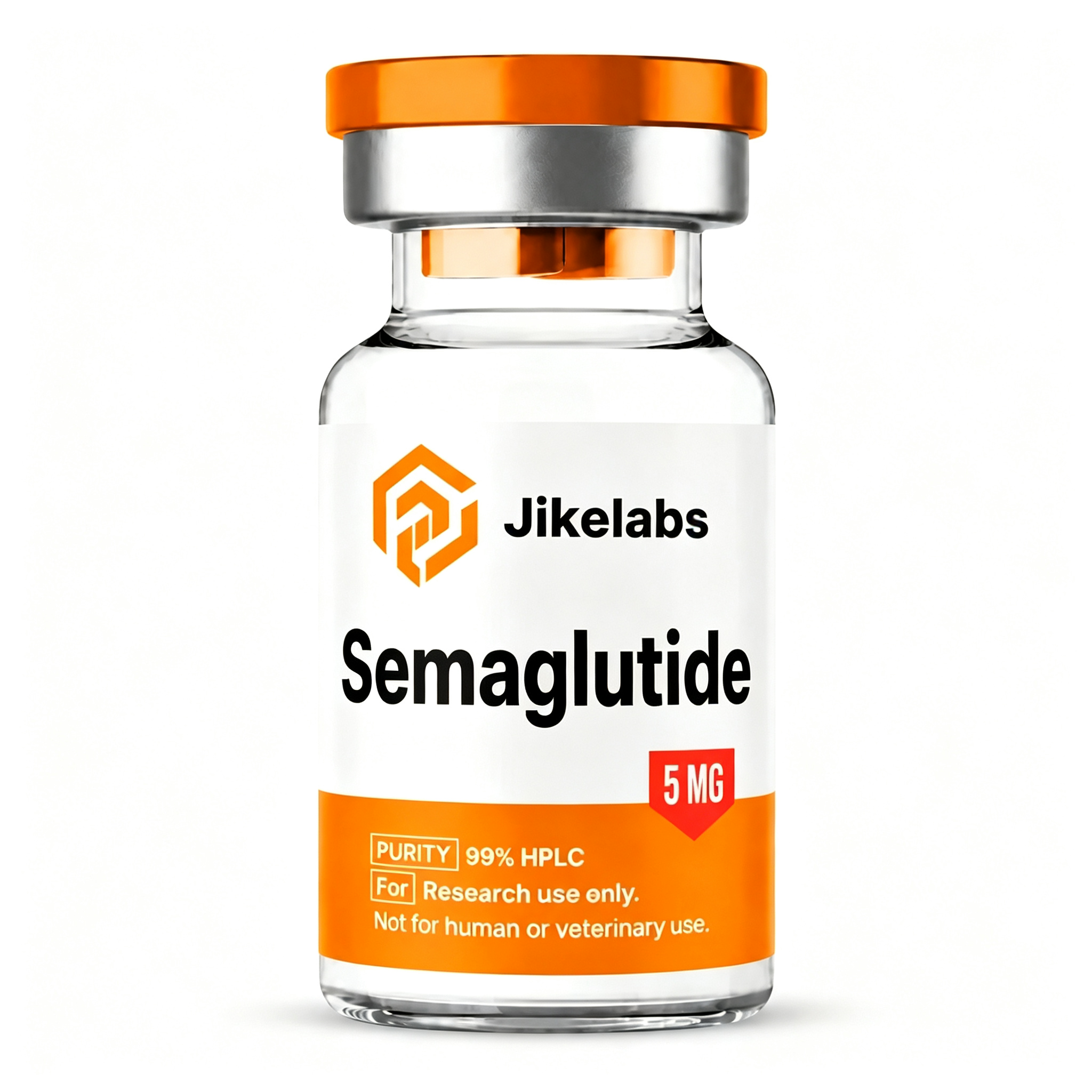
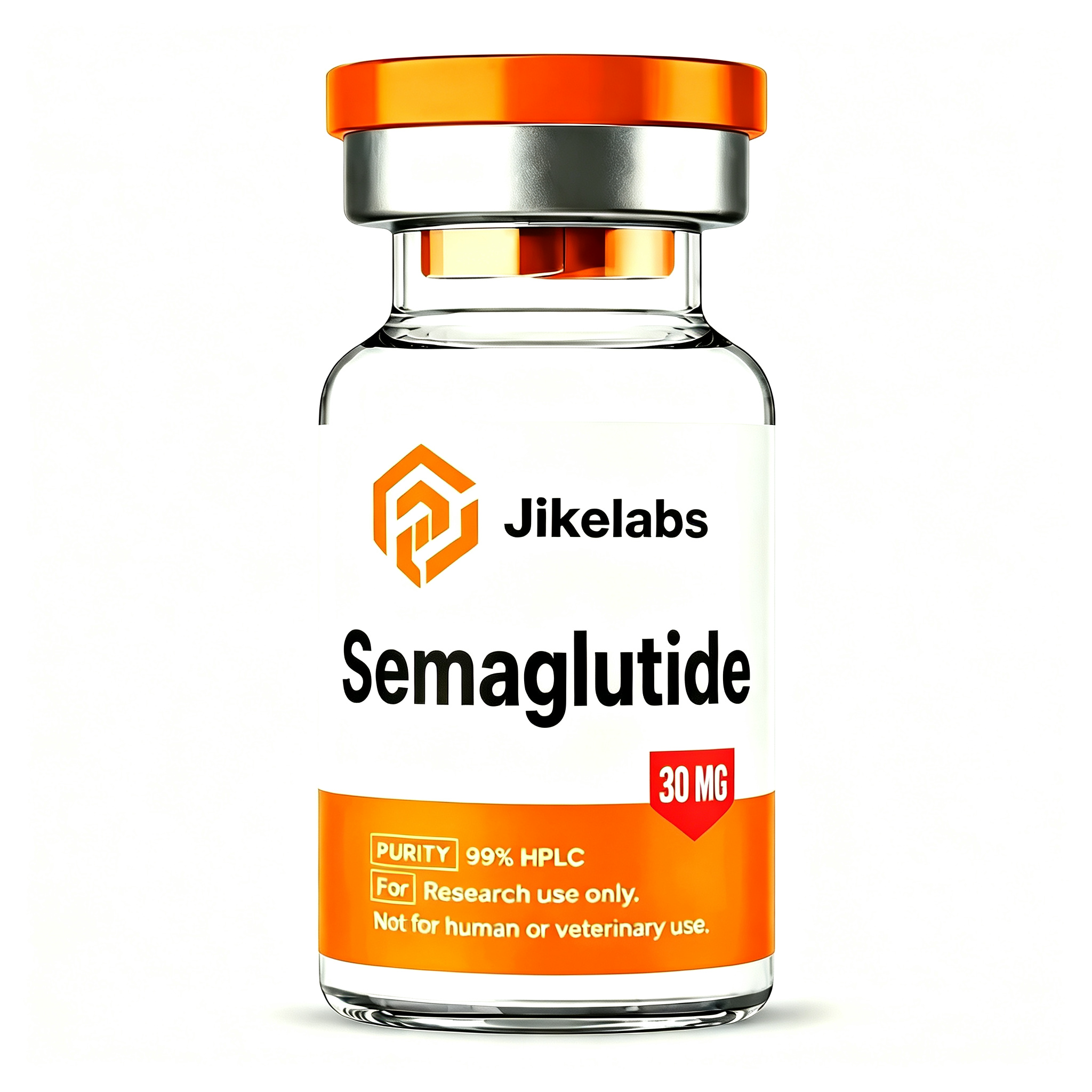
Semaglutide 5mg 10mg 15mg 20mg 30mg
-
Detail
Research Peptide · For Laboratory Use Only
Semaglutide 5mg
Long-Acting GLP-1 Receptor Agonist · C18 Fatty Diacid-Acylated Peptide · Lyophilized Powder · Purity ≥99% (HPLC)
Semaglutide is a long-acting glucagon-like peptide-1 (GLP-1) receptor agonist, engineered from the human GLP-1 sequence through three rational structural modifications: substitution of position 8 with α-aminoisobutyric acid (Aib) to resist DPP-4 enzymatic degradation, replacement of Lys³⁴ with Arg to direct a single acylation site, and attachment of a C18 fatty diacid chain at Lys²⁶ via a hydrophilic spacer, which enables strong albumin binding and extends the circulating half-life to roughly one week.
Originally developed by Novo Nordisk (marketed as Ozempic®, Wegovy® and Rybelsus®), Semaglutide has become one of the most extensively studied metabolic compounds in modern pharmacology — a benchmark GLP-1 receptor agonist in research on glucose homeostasis, appetite regulation, body composition and cardiovascular metabolism. Each vial is supplied as a sterile lyophilized (freeze-dried) powder to ensure maximum stability.
Product Specifications
Product Name Semaglutide (NN9535 / NN9931) CAS Number 910463-68-2 Structural Basis Modified human GLP-1 analog: Aib⁸ substitution (DPP-4 resistance), Arg³⁴ substitution, Lys²⁶ acylated with a C18 fatty diacid via a hydrophilic γ-Glu–2×OEG spacer Molecular Formula C₁₈₇H₂₉₁N₄₅O₅₉ Molecular Weight ≈ 4113.6 g/mol Target Profile Selective GLP-1 receptor (GLP-1R) agonist Quantity 5mg per vial Physical Form White to off-white lyophilized powder Purity ≥99% as determined by HPLC Storage -20°C for long term; 2–8°C for short term (lyophilized) What is Semaglutide?
GLP-1 (glucagon-like peptide-1) is an incretin hormone secreted by intestinal L cells in response to food intake. It stimulates glucose-dependent insulin secretion, suppresses glucagon, slows gastric emptying and signals satiety to the brain — but native GLP-1 is degraded by the DPP-4 enzyme within about two minutes, which limits its usefulness as a therapeutic molecule.
Semaglutide was designed to overcome this limitation through a landmark combination of peptide engineering and lipidation (Knudsen & Lau, 2019). The Aib⁸ substitution confers resistance to DPP-4 cleavage, while the C18 fatty diacid attached at Lys²⁶ drives reversible albumin binding in plasma — together extending the half-life to approximately 168 hours and enabling once-weekly dosing.
In published research, Semaglutide has been investigated in a wide range of settings, including:
- Type 2 diabetes and glucose homeostasis research, with robust HbA1c reduction reported in clinical trials;
- Obesity and body composition studies — phase III trials of once-weekly semaglutide 2.4 mg reported mean weight reductions of approximately 15–17% over 68 weeks;
- Cardiovascular outcomes research, including reduction of major adverse cardiovascular events in patients with type 2 diabetes;
- Emerging neuroscience research: GLP-1 receptor signaling in the brain, with preclinical studies exploring neuroprotective effects in models of Parkinson's disease and other neurodegenerative conditions.
Approved by the U.S. FDA, EMA and other major regulators, Semaglutide is one of the most clinically documented peptides in pharmaceutical history — and a reference molecule for the rapidly expanding GLP-1 receptor agonist class.
Mechanism of Action
Handling & Storage Guidelines
- Lyophilized powder: Store at -20°C for long-term stability; 2–8°C is acceptable for short-term storage. Avoid repeated temperature cycling and protect from moisture.
- Before opening: Allow the vial to reach room temperature and briefly centrifuge to ensure the full contents collect at the bottom of the vial.
- Reconstitution: As an acylated peptide, Semaglutide can self-associate into micelle-like aggregates in aqueous solution. Add solvent (bacteriostatic water or appropriate buffer) gently along the vial wall and allow adequate time for complete dissolution; avoid vigorous shaking.
- Reconstituted solution: Store at 2–8°C and use within the validated stability window; aliquot if needed and avoid repeated freeze-thaw cycles.
- General: Handle with standard laboratory protective equipment (gloves, lab coat, eye protection).
Why Choose Our Semaglutide?
🧪
Verified Purity
Each batch tested by HPLC & MS; COA available upon request.
📦
Secure Packaging
Sealed vials with temperature-protective packaging for safe delivery.
🚚
Fast Dispatch
Orders processed promptly with tracking provided.
Frequently Asked Questions
Q1: How does Semaglutide differ from Liraglutide?
A: Both are acylated GLP-1 receptor agonists from the same development lineage, but Semaglutide carries a longer C18 fatty diacid chain (vs. C16 in liraglutide), an Aib⁸ substitution for DPP-4 resistance, and a different acylation site — resulting in a half-life of roughly one week versus about 13 hours, and thus once-weekly versus once-daily dosing.
Q2: How does Semaglutide compare with Tirzepatide or Survodutide?
A: They target different receptor combinations. Semaglutide is a single GLP-1 receptor agonist; tirzepatide is a dual GIP/GLP-1 receptor agonist; survodutide is a dual glucagon/GLP-1 receptor agonist. The additional receptor engagement in the latter two adds complementary metabolic mechanisms (insulin sensitization or energy expenditure, respectively).
Q3: How should I store it after receiving?
A: Keep unopened vials at -20°C for long-term storage. Once reconstituted, refrigerate at 2–8°C and use promptly; aliquot and avoid repeated freeze-thaw cycles.
Q4: Is a Certificate of Analysis (COA) available?
A: Yes, third-party tested COA documentation can be provided for each batch. Please contact our customer service with your order number.
⚠ Research Use Only — Disclaimer
All product information provided on this page is solely for information dissemination and educational purposes. The products offered are intended exclusively for in vitro laboratory research and are not pharmaceuticals. They have not been approved by the U.S. Food and Drug Administration (FDA) or any other regulatory authority for the purposes sold here, and must not be used to prevent, treat or cure any medical condition, disease or ailment.
It is strictly prohibited to introduce these products into the human or animal body in any form. By purchasing, the buyer acknowledges full responsibility for the proper handling, use and compliance with all applicable local laws and regulations.
-
Customer ReviewsNo comments