
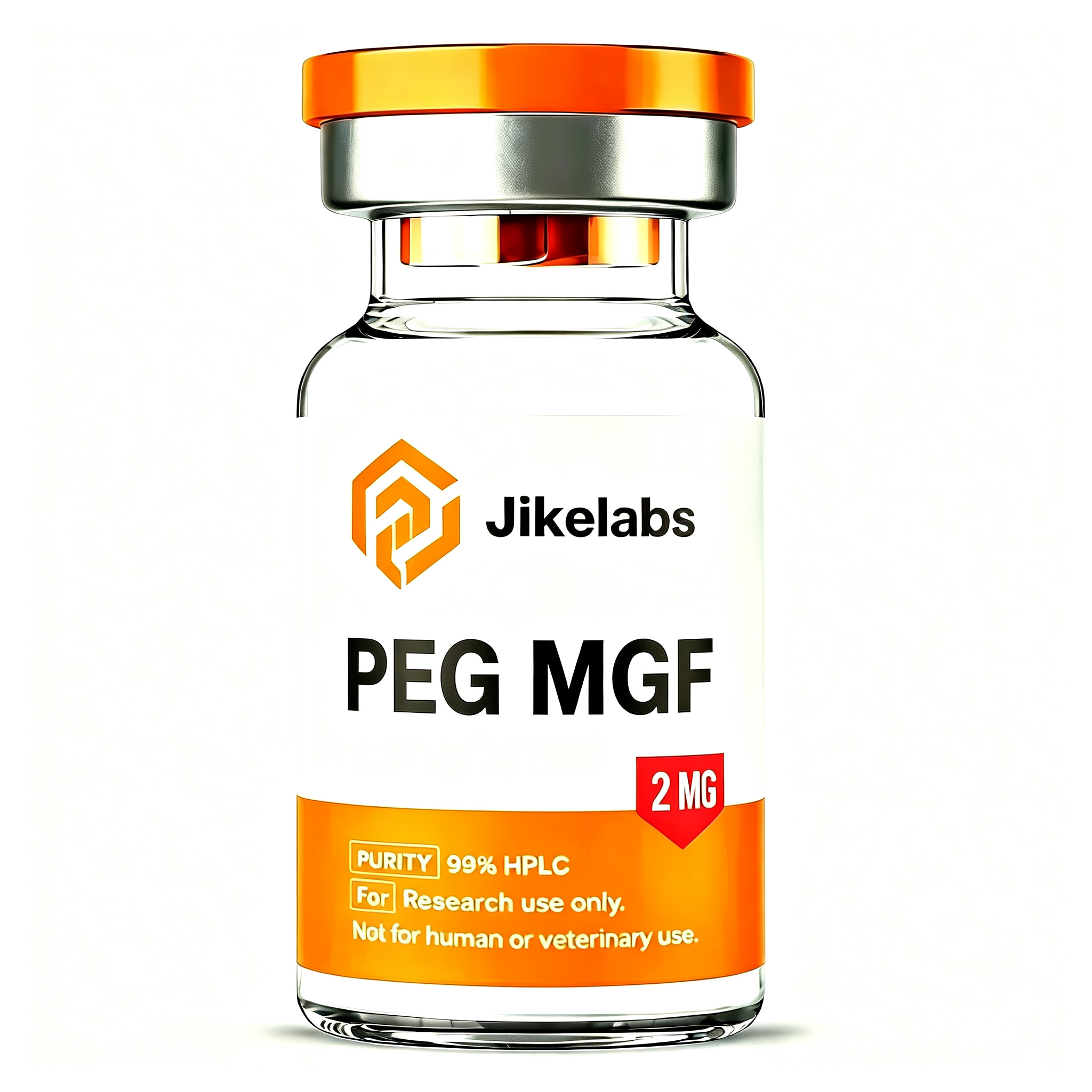
PEG MGF 2MG
PEG‑MGF is the pegylated modified derivative of native MGF (IGF‑1Ec). By covalently coupling polyethylene glycol (PEG) chains to the peptide molecule, PEG‑MGF solves the major defect of unmodified MGF: extremely short half‑life in liquid environment.
Unmodified MGF only survives for several minutes in plasma. After PEGylation modification, its half‑life is greatly prolonged, enabling stable systemic circulation in pre‑clinical research models.
In laboratory studies, PEG‑MGF is mainly investigated for activating muscle satellite stem cells, mediating muscle fiber repair and regeneration after injury. It is also applied for research of tissue recovery, anti‑inflammatory response and skeletal‑related biological mechanisms.
PEG‑MGF is supplied as lyophilized powder for lab research only. No complete human‑clinical safety and efficacy data are available.
-
Detail
PEG-MGF 2mg — PEGylated Mechano Growth Factor for Research
PEG-MGF (PEGylated Mechano Growth Factor) is a modified research peptide derived from Mechano Growth Factor (MGF), a splice variant of Insulin-like Growth Factor-1 (IGF-1, IGF-1Ec isoform). Native MGF is preferentially expressed in response to mechanical stress and tissue damage, playing a distinct role in cellular repair and regeneration — particularly in skeletal muscle tissue.
Because unmodified MGF has a remarkably short half-life in biological systems (measured in minutes), PEG-MGF is created by covalently attaching polyethylene glycol (PEG) chains to the native MGF sequence. This modification significantly extends the peptide's stability and activity duration while preserving its core biological activity — making it a more practical tool for laboratory investigation of MGF signaling.
Each vial contains 2mg of PEG-MGF, supplied as a sterile lyophilized (freeze-dried) powder to ensure maximum stability and long-term storage integrity.
▎Product Specifications
Product Name PEG-MGF (PEGylated Mechano Growth Factor) Synonyms PEGylated MGF; Mechano Growth Factor PEG Origin E-domain peptide of the IGF-1Ec splice variant, conjugated with polyethylene glycol (PEG) Molecular Weight Approx. 5,000 g/mol (peptide + PEG moiety; varies with PEG chain length) Quantity 2mg / vial Form Lyophilized powder Purity ≥99% as determined by HPLC Analytical Verification HPLC + Mass Spectrometry (MALDI-TOF confirmation of PEGylation) Certificate of Analysis COA available upon request / downloadable ▎Research Highlights
- Extended Half-Life vs. Native MGF: Native MGF is cleared within minutes in biological systems. PEGylation extends the peptide's activity duration significantly, making it suitable for longer research protocols and reducing dosing frequency in experimental settings.
- Preserved Bioactivity: Laboratory studies indicate that the PEG modification preserves the peptide's receptor binding affinity and its ability to activate IGF-1 receptor-associated signaling pathways.
- Enhanced Proteolytic Resistance: PEG-MGF demonstrates improved resistance to enzymatic degradation compared to unmodified MGF, facilitating long-term investigation of MGF signaling in cellular models.
- Satellite Cell & Muscle Repair Research: MGF is studied for its role in satellite cell activation and myoblast proliferation — key processes in skeletal muscle repair and regeneration research.
- Mechanically-Induced Isoform: As the IGF-1 splice variant expressed in response to mechanical stress and tissue damage, MGF is a compound of broad interest in exercise physiology and tissue repair studies.
▎Mechanism of Action (Summary)
PEG-MGF operates through mechanisms closely paralleling native Mechano Growth Factor:
- Binding to IGF-1 receptors on target cells, initiating intracellular signaling cascades;
- Activation of the PI3K/Akt signaling pathway, associated with cellular survival, growth, protein synthesis, and metabolic regulation;
- Stimulation of satellite cell activation and myoblast proliferation, key processes in muscle tissue research;
- Sustained receptor engagement provided by PEGylation, enabling signaling duration not achievable with native MGF in experimental protocols.
▎Storage & Handling
Lyophilized Powder Store at −20°C (2–8°C for shorter periods), dry and protected from light and moisture. Reconstitution Reconstitute with bacteriostatic water or sterile water. The PEG modification typically improves aqueous solubility compared to unmodified MGF. After Reconstitution Store reconstituted solutions at 2–8°C and use promptly. Prepare aliquots to minimize repeated freeze-thaw cycles. Handling Notes Centrifuge briefly before opening to recover all contents. Handle with standard laboratory protective equipment. Quality Assurance
Every batch of PEG-MGF is verified by HPLC for purity and Mass Spectrometry (MALDI-TOF) for molecular weight and PEGylation confirmation. A Certificate of Analysis (COA) is provided with each order, and independent third-party testing reports are available upon request.
Important Notice — Research Use Only
All product information on this page is provided solely for informational and educational purposes. The products offered are intended exclusively for laboratory and in vitro research. They are not pharmaceuticals, have not been approved by the U.S. Food and Drug Administration (FDA), and are not intended to diagnose, prevent, treat, or cure any medical condition. These products must not be administered to humans or animals. By purchasing, you confirm that you are a qualified researcher and that the product will be used only for lawful research purposes.
-
Customer ReviewsNo comments