
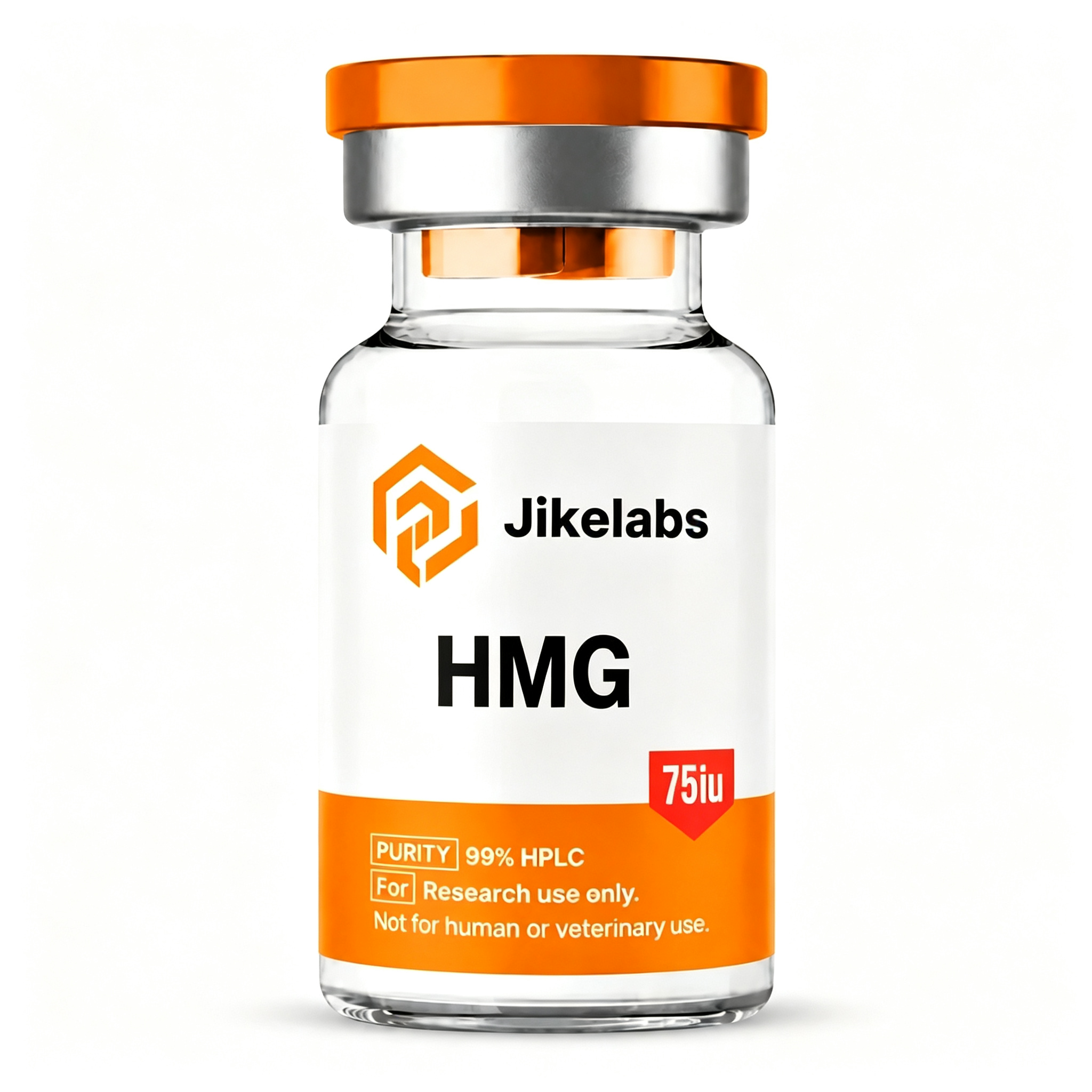
HMG 75iu
-
Detail
Gonadotropin Preparation · For Laboratory Use Only
HMG 75IU
Human Menopausal Gonadotropin · FSH 75IU + LH 75IU · Lyophilized Powder · Purified Natural Glycoprotein
HMG (Human Menopausal Gonadotropin), also known as menotropins, is a natural gonadotropin preparation extracted and purified from the urine of postmenopausal women — the same physiological source that has supplied gonadotropin therapy since the late 1950s. After menopause, the loss of ovarian feedback causes the pituitary to secrete large amounts of gonadotropins, which accumulate in urine and can be harvested in stable, high concentrations.
HMG carries dual gonadotropic activity: each 75IU vial contains follicle-stimulating hormone (FSH) activity of 75IU and luteinizing hormone (LH) activity of 75IU in an approximately 1:1 ratio — mirroring the natural pituitary combination. Both components are heterodimeric glycoproteins sharing a common α-subunit with distinct β-subunits that determine receptor selectivity. Each vial is supplied as a sterile lyophilized (freeze-dried) powder for stability and easy reconstitution.
Product Specifications
Product Name HMG (Human Menopausal Gonadotropin / Menotropins) CAS Number 9002-68-0 (Menotropins) Biological Activity FSH activity 75IU + LH activity 75IU per vial (≈1:1 ratio); activity calibrated against WHO International Standard reference preparations Molecular Nature Natural mixture of heterodimeric glycoproteins (FSH and LH), each composed of a common α-subunit and a hormone-specific β-subunit; no single molecular formula applies to the preparation Source Extracted and purified from urine of postmenopausal women Quantity 75IU per vial Physical Form White to off-white lyophilized powder Purity / QC Sterile-filtered; tested for protein content, activity ratio and microbial contamination; COA available upon request Storage 2–8°C for long term (recommended); -20°C acceptable; avoid repeated freeze-thaw once reconstituted What is HMG?
HMG belongs to the gonadotropin family — the pituitary hormones that govern reproductive function. Unlike single-hormone preparations (pure FSH, pure LH or HCG), HMG preserves the natural FSH + LH combination exactly as the pituitary secretes it, which is why it has been the workhorse of ovarian stimulation and gonadotropin research for more than sixty years, from the first clinical ovulation induction reported in 1961 through modern assisted reproduction protocols.
The two active components work as a coordinated pair:
- FSH (Follicle-Stimulating Hormone) — the primary driver of follicular recruitment, growth and maturation; stimulates granulosa cell proliferation and estradiol synthesis;
- LH (Luteinizing Hormone) — supports theca-cell androgen production that fuels follicle development, participates in final oocyte maturation and luteal support, and is essential for the steroidogenic milieu of a healthy cycle.
In published research, HMG has been investigated in a wide range of settings, including:
- Ovulation induction and controlled ovarian stimulation studies — the classical application since the 1960s, including comparison trials against recombinant FSH in IVF/ICSI cycles;
- Hypogonadotropic hypogonadism research — both female anovulation and male hypogonadotropic models, where the FSH + LH combination is required to restore gonadal function;
- Male reproductive research — HMG supports seminiferous tubule development and spermatogenesis in low-gonadotropin models, complementing or following HCG-based protocols;
- Reproductive endocrinology and steroidogenesis studies — as a physiologically balanced natural gonadotropin source;
- Veterinary and animal science superovulation research, where HMG is widely used to study multi-follicular development.
As a natural, urine-derived preparation with a long documented history, HMG remains a reference standard for gonadotropin activity and a preferred choice wherever combined FSH + LH stimulation is required.
Mechanism of Action
Handling & Storage Guidelines
- Lyophilized powder: Store at 2–8°C for long-term stability; -20°C is also acceptable. Protect from light, heat and moisture, and avoid repeated temperature cycling.
- Before opening: Allow the vial to reach room temperature and briefly centrifuge to ensure the full contents collect at the bottom of the vial.
- Reconstitution: Add the supplied diluent or sterile saline / bacteriostatic water gently along the vial wall. Swirl slowly until fully dissolved; avoid vigorous shaking, which can denature glycoproteins and cause foaming.
- Reconstituted solution: Use immediately after reconstitution — do not store reconstituted HMG for extended periods, and never refreeze the solution.
- General: Handle with standard laboratory protective equipment (gloves, lab coat, eye protection).
Why Choose Our HMG?
🧪
Verified Activity
Each batch assayed for FSH/LH activity and sterility; COA available upon request.
📦
Cold-Chain Packaging
Temperature-protective packaging keeps glycoproteins stable in transit.
🚚
Fast Dispatch
Orders processed promptly with tracking provided.
Frequently Asked Questions
Q1: What is the difference between HMG and HCG?
A: They are different hormones with different roles. HMG contains FSH + LH and drives follicle development (in female models) or spermatogenic support (in male models). HCG mimics LH and is typically used as the final ovulation trigger or for luteal/Leydig-cell support. The two are often used sequentially in protocols — HMG for stimulation, HCG for the trigger step.
Q2: How is HMG different from recombinant FSH (rFSH)?
A: Recombinant FSH is a single, DNA-engineered hormone containing only FSH activity. HMG is a natural urine-derived preparation containing both FSH and LH activity in an approximately 1:1 ratio. Research comparing the two in stimulation protocols remains active; the LH component of HMG is the key functional difference.
Q3: What does "75IU" refer to?
A: One 75IU vial delivers 75 International Units of FSH activity plus 75 International Units of LH activity — the standard vial strength used across gonadotropin research. The unit is a biological activity measure calibrated against WHO reference standards, not a mass measure.
Q4: Why is HMG extracted from postmenopausal urine?
A: After menopause, ovarian feedback ceases and the pituitary secretes gonadotropins at very high, stable levels (reaching 60–100 IU/L of urine), which accumulate in urine. This makes postmenopausal urine a rich, consistent natural source of FSH and LH.
Q5: How should I store it after receiving?
A: Keep unopened vials at 2–8°C (or -20°C). Use immediately after reconstitution; do not store or refreeze the reconstituted solution.
Q6: Is a Certificate of Analysis (COA) available?
A: Yes, batch documentation covering activity assay and sterility testing can be provided. Please contact our customer service with your order number.
⚠ Research Use Only — Disclaimer
All product information provided on this page is solely for information dissemination and educational purposes. The products offered are intended exclusively for in vitro laboratory research and are not pharmaceuticals. They have not been approved by the U.S. Food and Drug Administration (FDA) or any other regulatory authority for the purposes sold here, and must not be used to prevent, treat or cure any medical condition, disease or ailment.
It is strictly prohibited to introduce these products into the human or animal body in any form. By purchasing, the buyer acknowledges full responsibility for the proper handling, use and compliance with all applicable local laws and regulations.
-
Customer ReviewsNo comments