
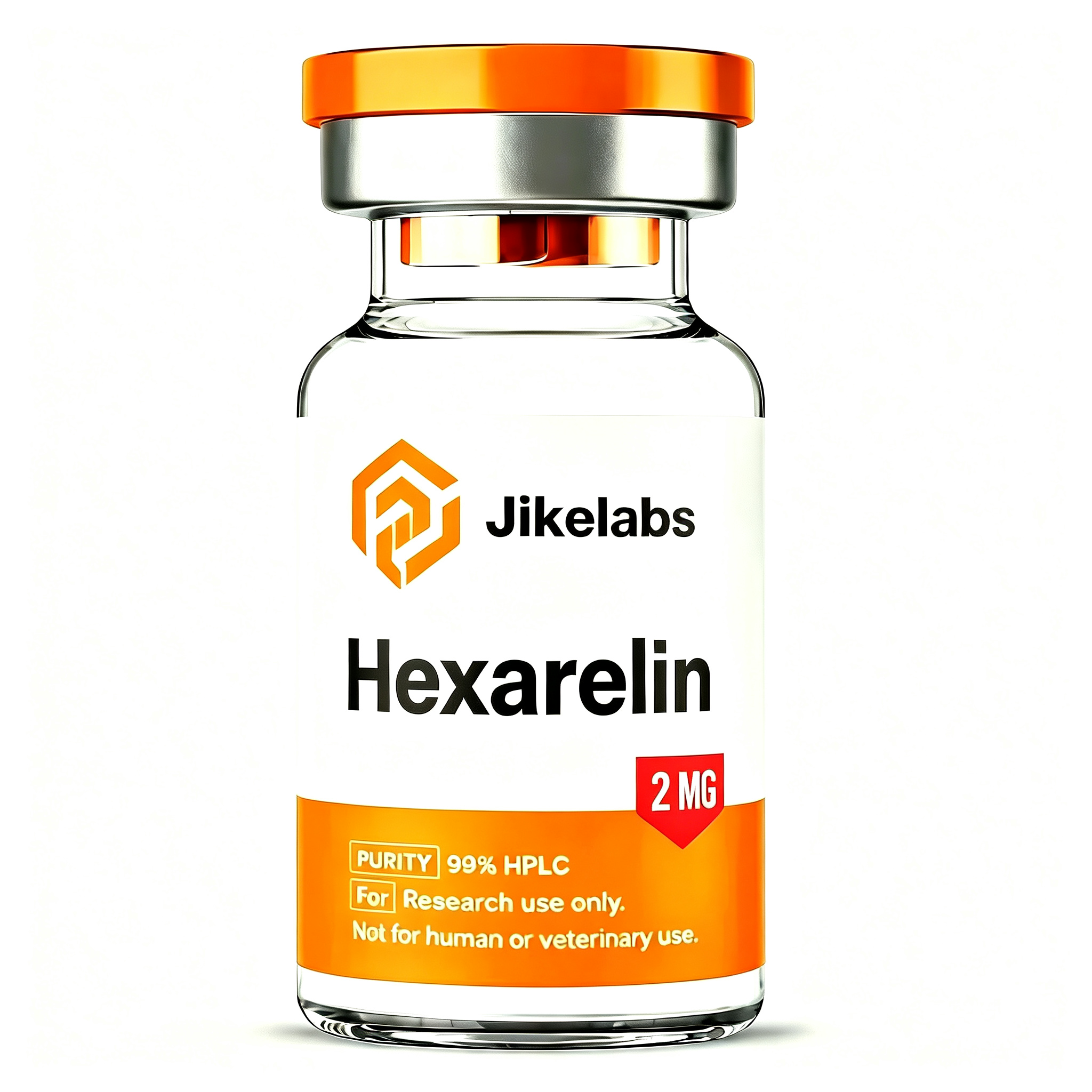
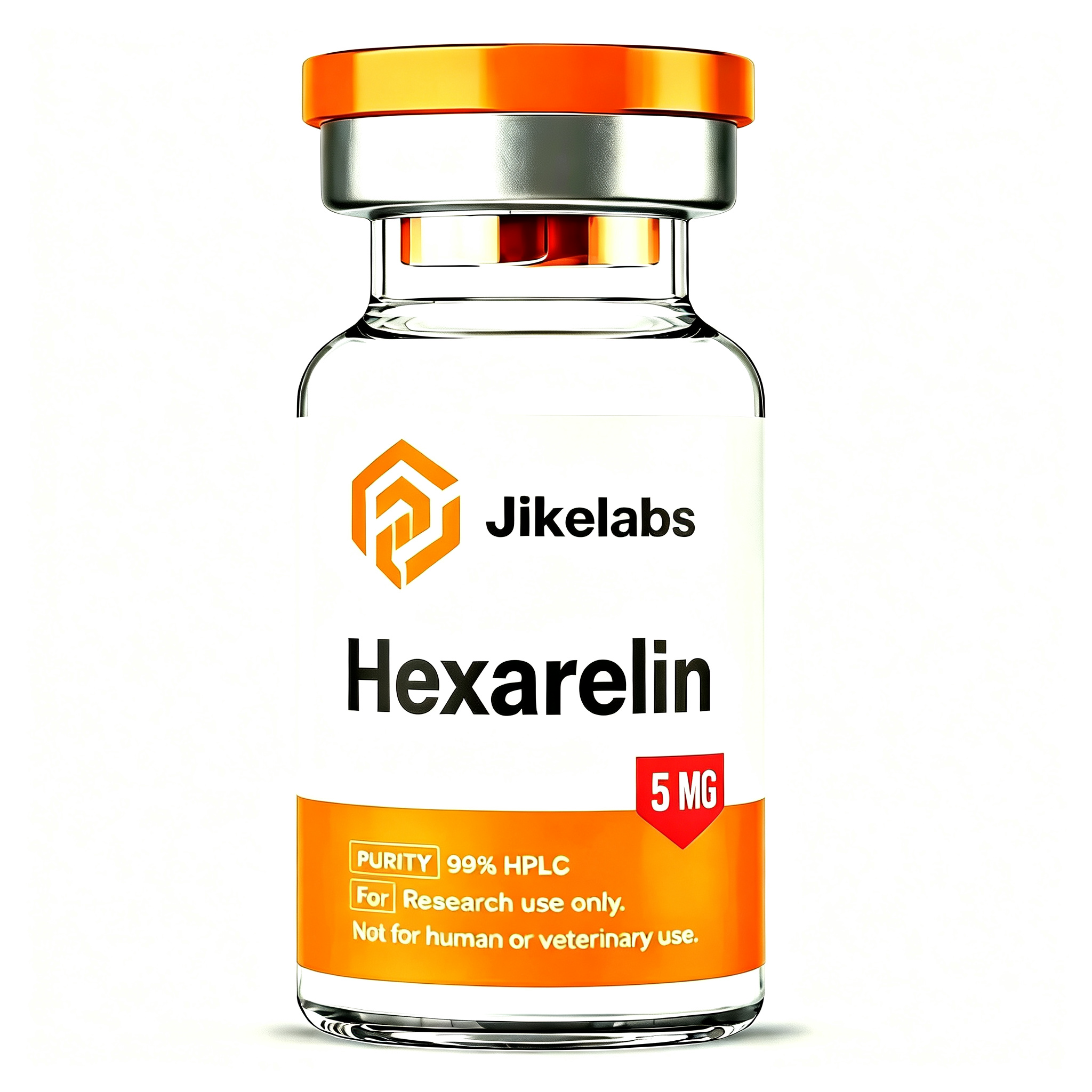
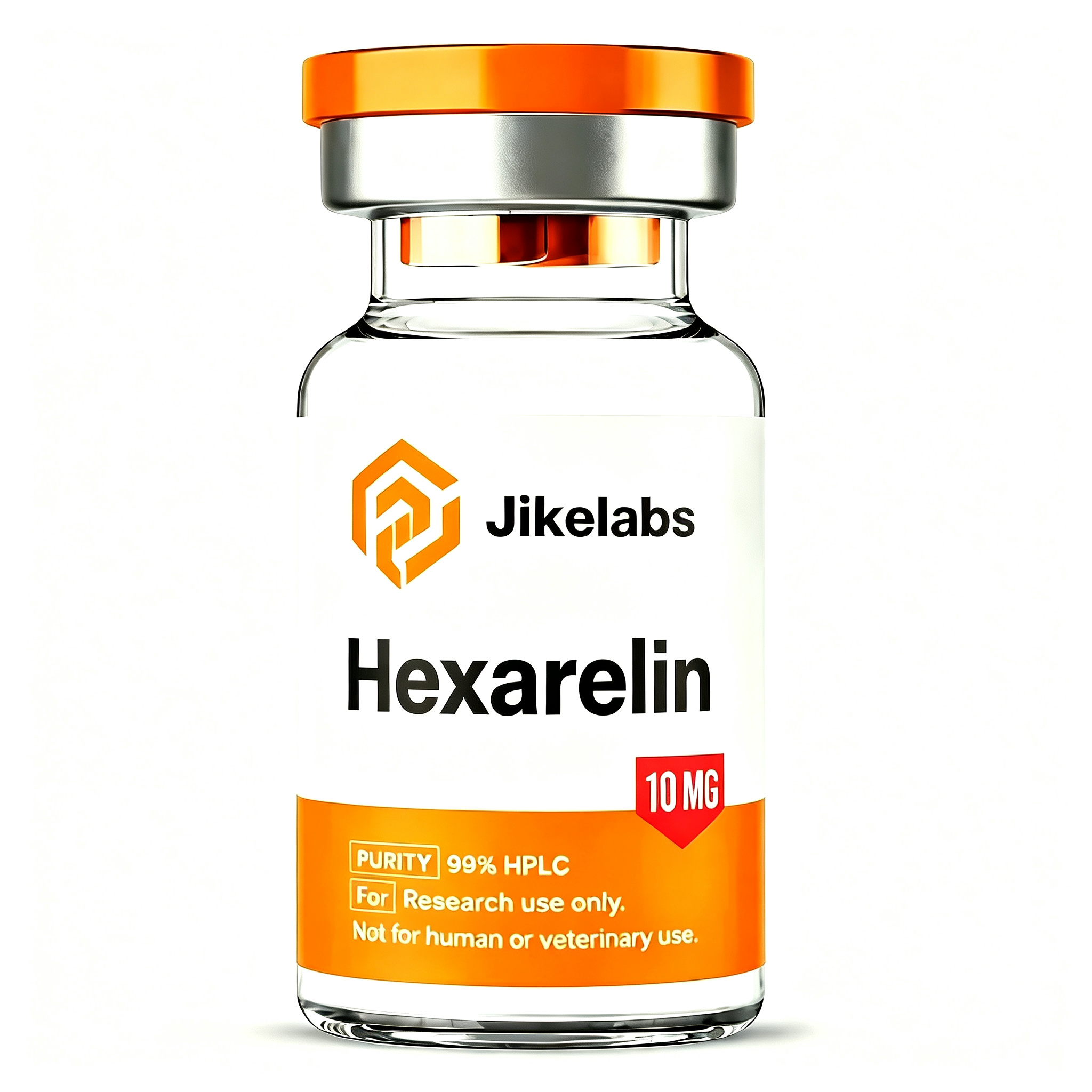
Hexarelin 2MG 5MG 10MG
-
Detail
Research Peptide · For Laboratory Use Only
Hexarelin (Examorelin) 5mg
Growth Hormone Secretagogue · GHRP-6 Analog Hexapeptide · Lyophilized Powder · Purity ≥98% (HPLC)
Hexarelin, also known by its international nonproprietary name Examorelin (development codes EP-23905 and MF-6003), is a synthetic hexapeptide growth hormone secretagogue (GHS) and a highly selective agonist of the ghrelin / growth hormone secretagogue receptor (GHS-R1a). Its sequence — His-D-2-methyl-Trp-Ala-Trp-D-Phe-Lys-NH₂ — was derived from the GHRP-6 analog research lineage, with the key modification of replacing D-Trp by 2-methyl-D-Trp to improve potency and metabolic stability.
Hexarelin is one of the most thoroughly studied members of the GHRP family: in clinical research it proved to be a potent, dose-dependent stimulator of growth hormone release — and remarkably, one of the few GH-releasing peptides active after oral and intranasal administration. It reached Phase II clinical trials for growth hormone deficiency and congestive heart failure before development was discontinued. Each vial is supplied as a sterile lyophilized (freeze-dried) powder to ensure maximum stability.
Product Specifications
Product Name Hexarelin (Examorelin) CAS Number 140703-51-1 (free base) Amino Acid Sequence His-D-2-methyl-Trp-Ala-Trp-D-Phe-Lys-NH₂ (synthetic hexapeptide derived from GHRP-6, with 2-methyl-D-Trp substituted at position 2 and a C-terminal amide) Molecular Formula C₄₇H₅₈N₁₂O₆ Molecular Weight 887.04 g/mol (free base) Receptor Profile Highly selective GHS-R1a (ghrelin / growth hormone secretagogue receptor) agonist Quantity 5mg per vial Physical Form White to off-white lyophilized powder Purity ≥99% as determined by HPLC Storage -20°C for long term; 2–8°C for short term (lyophilized) What is Hexarelin?
The discovery of ghrelin — the stomach-derived natural ligand of the growth hormone secretagogue receptor — transformed the study of growth hormone regulation. Before ghrelin was even identified, medicinal chemists had already built a family of synthetic receptor agonists that mimicked its GH-releasing action: the growth hormone-releasing peptides (GHRPs). Hexarelin was developed by Mediolanum Farmaceutici as one of the most advanced members of this family.
Hexarelin was engineered from the GHRP-6 template to deliver stronger and more durable GH release. Its key structural features include:
- 2-methyl-D-Trp replacing the D-Trp of GHRP-6, enhancing receptor affinity and resistance to enzymatic degradation;
- A hexapeptide backbone (His–D-2-methyl-Trp–Ala–Trp–D-Phe–Lys) conserved across the GHRP pharmacophore;
- A C-terminal amide (Lys-NH₂), stabilizing the peptide against carboxypeptidase cleavage.
In published research, Hexarelin has been investigated in a wide range of settings, including:
- Growth hormone physiology — Hexarelin releases more GH than GHRH in humans and shows striking synergy when combined with GHRH; it reached Phase II clinical trials for growth hormone deficiency;
- Pediatric growth research — intranasal Hexarelin was studied in short children as a non-injectable GH-releasing approach;
- Cardiovascular research — Hexarelin has demonstrated cardioprotective effects in ischemia-reperfusion, myocardial infarction and cardiac fibrosis models, mediated through GHS-R1a and the CD36 receptor;
- Congestive heart failure — Hexarelin advanced to Phase II trials in CHF patients before development was discontinued;
- Aging and body composition studies, where GH secretagogues serve as tools to explore the somatotropic (GH/IGF-1) axis.
With a clinical history spanning GH deficiency, short stature and heart failure research — plus an exceptional feature of oral and intranasal activity — Hexarelin remains one of the best-characterized research tools for studying the ghrelin receptor and the growth hormone axis.
Mechanism of Action
Handling & Storage Guidelines
- Lyophilized powder: Store at -20°C for long-term stability; 2–8°C is acceptable for short-term storage. Avoid repeated temperature cycling and protect from light and moisture.
- Before opening: Allow the vial to reach room temperature and briefly centrifuge to ensure the full contents collect at the bottom of the vial.
- Reconstitution: Add bacteriostatic water or an appropriate solvent gently along the vial wall. Swirl slowly until fully dissolved; avoid vigorous shaking. Peptides are fragile molecules — gentle handling preserves structural integrity.
- Reconstituted solution: Store at 2–8°C and use promptly; do not refreeze the solution.
- General: Handle with standard laboratory protective equipment (gloves, lab coat, eye protection).
Why Choose Our Hexarelin?
🧪
Verified Purity
Each batch tested by HPLC & MS; COA available upon request.
📦
Secure Packaging
Sealed vials with temperature-protective packaging for safe delivery.
🚚
Fast Dispatch
Orders processed promptly with tracking provided.
Frequently Asked Questions
Q1: Is Hexarelin the same as Examorelin?
A: Yes. Hexarelin is the original research name; Examorelin is the same molecule's international nonproprietary name (INN). It was also known under the development codes EP-23905 and MF-6003.
Q2: How does Hexarelin differ from GHRP-6 and GHRP-2?
A: All three belong to the GHRP family and act through the same ghrelin receptor (GHS-R1a). Hexarelin was derived from the GHRP-6 sequence, with 2-methyl-D-Trp substituted at position 2 — a modification reported to make it a more potent and longer-acting GH releaser than GHRP-6. GHRP-2 (pralmorelin) is a closely related hexapeptide with a different substitution pattern; hexarelin's development history is distinguished by its oral/intranasal activity and cardiovascular research program.
Q3: How does Hexarelin differ from Ipamorelin or CJC-1295?
A: The mechanisms differ. Hexarelin is a GH secretagogue (ghrelin receptor agonist), while CJC-1295 is a GHRH analog acting through the GHRH receptor — the two pathways are complementary and often studied together. Ipamorelin is also a secretagogue, but is noted for its selectivity (minimal prolactin/ACTH/cortisol stimulation), whereas Hexarelin is characterized by stronger GH-releasing potency with mild co-release of prolactin and cortisol.
Q4: How should I store it after receiving?
A: Keep unopened vials at -20°C for long-term storage. Once reconstituted, refrigerate at 2–8°C and use promptly; do not refreeze the solution.
Q5: Is a Certificate of Analysis (COA) available?
A: Yes, third-party tested COA documentation can be provided for each batch. Please contact our customer service with your order number.
⚠ Research Use Only — Disclaimer
All product information provided on this page is solely for information dissemination and educational purposes. The products offered are intended exclusively for in vitro laboratory research and are not pharmaceuticals. They have not been approved by the U.S. Food and Drug Administration (FDA) or any other regulatory authority for the purposes sold here, and must not be used to prevent, treat or cure any medical condition, disease or ailment.
It is strictly prohibited to introduce these products into the human or animal body in any form. By purchasing, the buyer acknowledges full responsibility for the proper handling, use and compliance with all applicable local laws and regulations.
-
Customer ReviewsNo comments