
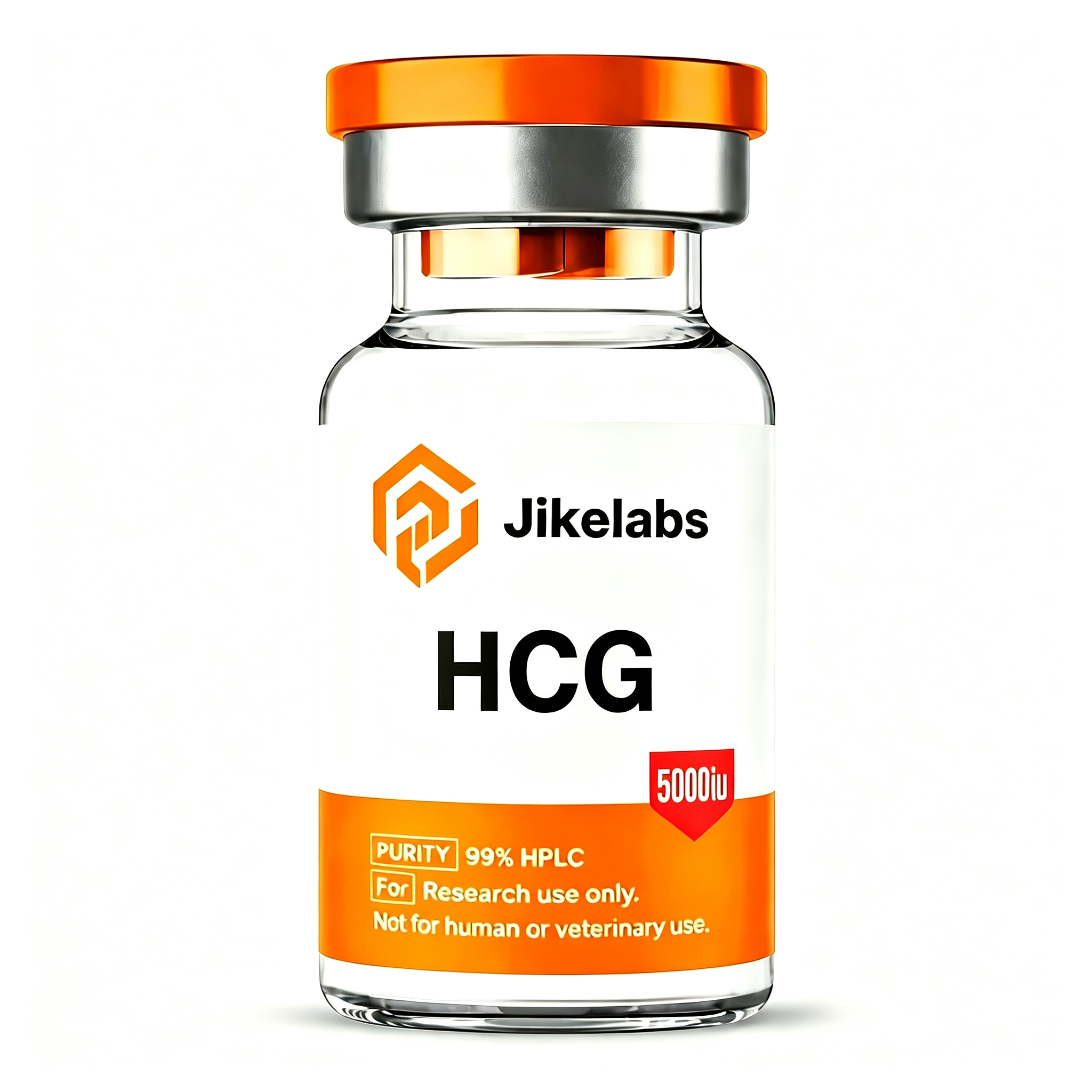
HCG 5000iu 10000iu
-
Detail
Research Peptide · For Laboratory Use Only
HCG (Human Chorionic Gonadotropin) 5000IU
Gonadotropic Glycoprotein Hormone · LH/CG Receptor Agonist · Lyophilized Powder · Purity ≥98%
HCG — Human Chorionic Gonadotropin — is a naturally occurring glycoprotein hormone composed of 237 amino acids, produced in the body by the syncytiotrophoblast cells of the placenta. It is a heterodimer consisting of an α-subunit identical to that of LH, FSH and TSH, and a β-subunit unique to HCG that confers its specific biological activity. HCG acts as a highly selective agonist of the LH/CG receptor (LHCGR), functionally mimicking luteinizing hormone while enjoying a substantially longer circulating half-life thanks to its unique C-terminal peptide (β-CTP) carrying four O-linked carbohydrate chains.
HCG is one of the most widely characterized gonadotropins in biomedical research: it is the hormone detected by pregnancy tests, a classical tool in reproductive endocrinology, and a standard reference ligand for LH/CG receptor studies. Each vial is supplied as a sterile lyophilized (freeze-dried) powder with a biological activity of 5000 international units (IU) to ensure maximum stability.
Product Specifications
Product Name HCG (Human Chorionic Gonadotropin) CAS Number 9002-61-3 Molecular Nature Heterodimeric glycoprotein, 237 amino acids total: α-subunit (92 amino acids, shared with LH/FSH/TSH) non-covalently associated with a β-subunit (145 amino acids, unique to HCG, bearing a C-terminal peptide with four O-linked glycosylation sites) Molecular Weight ≈36.7 kDa (α-subunit ≈14.5 kDa, β-subunit ≈22.2 kDa; actual mass varies with glycosylation) Receptor Profile Selective LH/CG receptor (LHCGR) agonist — functionally mimics luteinizing hormone with a longer half-life Biological Activity 5000 IU per vial (potency calibrated against the WHO International Standard) Quantity 5000IU per vial Physical Form White to off-white lyophilized powder Purity ≥98% as determined by SDS-PAGE / HPLC Storage -20°C for long term; 2–8°C for short term (lyophilized) What is HCG?
Human chorionic gonadotropin is the hormone of pregnancy recognition. After implantation, the developing placenta secretes HCG into the maternal circulation, where it rescues and maintains the corpus luteum — keeping progesterone production alive through the first trimester. This very function is what every over-the-counter pregnancy test detects: the appearance of HCG (specifically its unique β-subunit) in blood or urine.
Structurally, HCG belongs to the glycoprotein hormone family alongside LH, FSH and TSH. All four share an identical α-subunit; each carries a distinct β-subunit that determines receptor specificity. What sets HCG apart from LH is its β-subunit's extended C-terminal peptide (β-CTP), which carries four O-linked sugar chains and:
- extends the circulating half-life of HCG to roughly 24–36 hours — several times longer than LH;
- contributes to its high bioactivity at the shared LH/CG receptor.
In published research, HCG has been investigated in a wide range of settings, including:
- Reproductive endocrinology — as the classical trigger for final oocyte maturation and ovulation in fertility research and assisted reproduction protocols;
- Male reproductive biology — stimulation of Leydig cells and intratesticular testosterone production, a cornerstone of research into hypogonadism and fertility preservation;
- LH/CG receptor pharmacology — HCG remains a reference ligand in LHCGR binding, signaling and structural studies;
- Diagnostic and immunoassay research — β-HCG is an established tumor marker in germ cell and trophoblastic disease research, and the analyte underlying all pregnancy diagnostics;
- Cell culture applications — HCG is widely used as a bioactive supplement in in vitro culture systems.
With nearly a century of research history since its discovery, HCG stands as one of the most thoroughly characterized glycoprotein hormones ever studied — an indispensable reference molecule for any laboratory working on the hypothalamic-pituitary-gonadal axis.
Mechanism of Action
Handling & Storage Guidelines
- Lyophilized powder: Store at -20°C for long-term stability; 2–8°C is acceptable for short-term storage. Avoid repeated temperature cycling and protect from light and moisture.
- Before opening: Allow the vial to reach room temperature and briefly centrifuge to ensure the full contents collect at the bottom of the vial.
- Reconstitution: Add bacteriostatic water or an appropriate solvent gently along the vial wall. Swirl slowly until fully dissolved; avoid vigorous shaking. As a glycoprotein, HCG is more fragile than small peptides — gentle handling is essential to preserve its quaternary structure and biological activity.
- Reconstituted solution: Store at 2–8°C and use promptly; do not refreeze the solution.
- General: Handle with standard laboratory protective equipment (gloves, lab coat, eye protection).
Why Choose Our HCG?
🧪
Verified Quality
Each batch tested by SDS-PAGE & HPLC; COA available upon request.
📦
Secure Packaging
Sealed vials with temperature-protective packaging for safe delivery.
🚚
Fast Dispatch
Orders processed promptly with tracking provided.
Frequently Asked Questions
Q1: What does "5000IU" mean — is it different from milligrams?
A: Yes. HCG is a glycoprotein whose actual mass varies with glycosylation, so its potency is expressed in international units (IU) calibrated against the WHO reference standard rather than in milligrams. 5000IU refers to the certified biological activity per vial.
Q2: How does HCG differ from LH (luteinizing hormone)?
A: HCG and LH share the same α-subunit and act on the same receptor (LHCGR), but HCG's unique β-subunit carries an extended C-terminal peptide with additional sugar chains. This gives HCG a circulating half-life of roughly 24–36 hours — several times longer than LH — and makes it the practical LH mimetic used in research.
Q3: How does HCG differ from HMG (menotropins)?
A: HMG is a mixture of gonadotropins containing both FSH and LH activities, whereas HCG is a single molecule with LH-like activity only. In research, the two are used for different purposes: HMG where combined FSH/LH stimulation is required, HCG where pure LH/CG receptor activation is needed.
Q4: How should I store it after receiving?
A: Keep unopened vials at -20°C for long-term storage. Once reconstituted, refrigerate at 2–8°C and use promptly; do not refreeze the solution, as freeze-thaw cycling damages the glycoprotein structure.
Q5: Is a Certificate of Analysis (COA) available?
A: Yes, third-party tested COA documentation can be provided for each batch. Please contact our customer service with your order number.
⚠ Research Use Only — Disclaimer
All product information provided on this page is solely for information dissemination and educational purposes. The products offered are intended exclusively for in vitro laboratory research and are not pharmaceuticals. They have not been approved by the U.S. Food and Drug Administration (FDA) or any other regulatory authority for the purposes sold here, and must not be used to prevent, treat or cure any medical condition, disease or ailment.
It is strictly prohibited to introduce these products into the human or animal body in any form. By purchasing, the buyer acknowledges full responsibility for the proper handling, use and compliance with all applicable local laws and regulations.
-
Customer ReviewsNo comments