
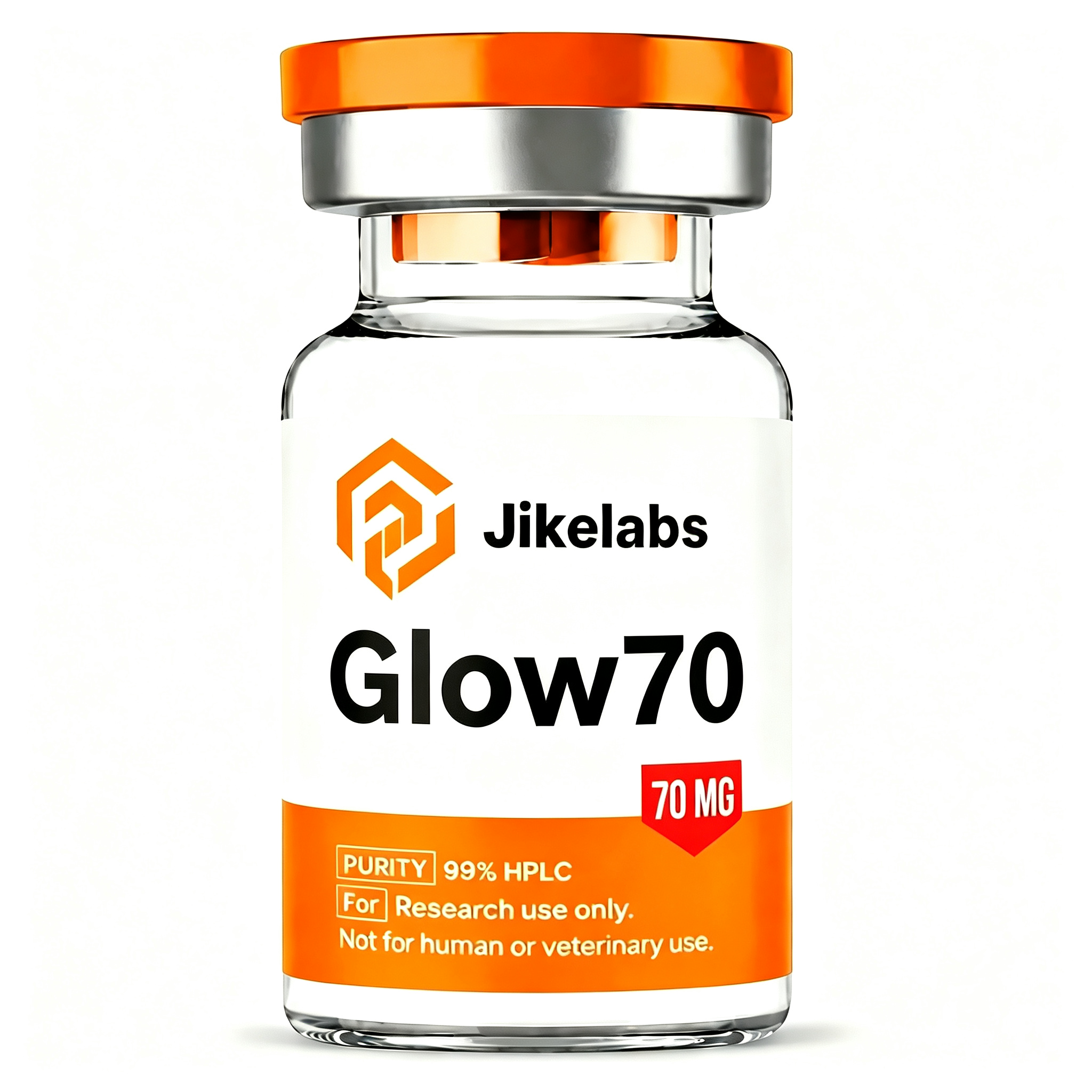
Glow 70mg (Blend)TB500+BPC+GHK-CU
BPC 157, a synthetic peptide, demonstrates extensive biological functions, including tissue repair, neuroprotection, anti-ulcer, anti-inflammatory, and antioxidant effects, with notable efficacy in accelerating wound healing and supporting gastrointestinal and liver health.
GHK-Cu, a tripeptide copper chelate, displays a broad spectrum of biological activities such as antioxidant, anti-inflammatory, and collagen-synthesis promotion, offering significant benefits for skin health and tissue repair.
The combination of TB-500, BPC157, and GHK-Cu presents synergistic advantages in wound healing, tissue repair, anti-inflammation, neuroprotection, and skin health and beauty.
-
Detail
GLOW 70mg × 10 Vials Kit (700mg Total)
Three-Phase Tissue Repair Blend | GHK-Cu 50mg + BPC-157 10mg + TB-500 10mg Per Vial
10-Vial Research Kit · Fixed-Ratio Lyophilized Blend · Research Use Only
📦 10-Vial Kit Value
700mg of total peptide across 10 sealed vials — designed for extended research programs with better per-mg value than single vials.
🔗 3-Pathway Repair
Collagen remodeling (GHK-Cu), angiogenesis (BPC-157) and cell migration (TB-500) engaged in one fixed-ratio formulation.
🧊 Vial-by-Vial Stability
Unopened lyophilized vials keep their full shelf life — open one vial at a time, keep the rest frozen and untouched.
⚖ 71.4% GHK-Cu
GHK-Cu dominates each dose (50/10/10 ratio) — a collagen and matrix-remodeling focused formula.
What's in This Kit
Item Per Vial Kit Total (×10) GHK-Cu (Copper Tripeptide) 50 mg 500 mg BPC-157 (Body Protection Compound) 10 mg 100 mg TB-500 (Thymosin Beta-4 Fragment) 10 mg 100 mg Total Net Peptide 70 mg 700 mg Each vial is an independent, sealed lyophilized blend — the three peptides are pre-combined at a fixed 5:1:1 mass ratio, so every vial reconstitutes identically.
Why the 10-Vial Format
🕐 Built for long-term programs — multi-week or multi-month research protocols consume material steadily. Ten vials remove the need for repeat orders and keep the same batch characteristics across the entire study window.
🧊 Shelf-life protection — lyophilized peptides are most stable in their sealed, unopened state. With a multi-vial kit you only reconstitute what you need now; the remaining vials stay frozen at full stability until opened.
💰 Better value per milligram — kit pricing typically works out lower per mg than buying single vials, with identical lot-specific COA documentation for every vial.
Product Overview
The GLOW blend pairs three of the most extensively studied tissue-repair peptides in a single fixed-ratio lyophilized vial: GHK-Cu — a copper tripeptide researched for collagen synthesis and matrix remodeling — BPC-157 — a gastric pentadecapeptide researched for angiogenesis and cytoprotection — and TB-500 — the biologically active fragment of thymosin beta-4 researched for actin regulation and cell migration.
The rationale is mechanistic complementarity: BPC-157 supports the vascular network that healing tissue needs, TB-500 drives the migration of repair cells along that network, and GHK-Cu activates the collagen and matrix-remodeling programs those cells execute. With GHK-Cu at 71.4% of every dose, the formula is oriented toward collagen-dense and matrix-rich research contexts.
This listing supplies 10 sealed vials of 70mg each (700mg total net peptide) as a single kit, for in-vitro and laboratory research use only.
Specifications
Product Name GLOW Peptide Blend — 10-Vial Kit Kit Configuration 10 vials × 70 mg (50mg GHK-Cu + 10mg BPC-157 + 10mg TB-500 per vial) Physical Form White to off-white lyophilized powder, no fillers Purity ≥ 99% (by HPLC, per component) Solubility Water-soluble Storage Store lyophilized vials at -20°C, protected from light and moisture; after reconstitution, refrigerate and use within your validated stability window The Three Components
1. GHK-Cu — 50mg / vial (Copper Peptide)
CAS 89030-95-5 · C₁₄H₂₄CuN₆O₄ · MW ≈ 403.9 g/mol · 3 residues
Glycyl-L-Histidyl-L-Lysine bound to a copper(II) ion, first isolated from human plasma in 1973. Stimulates collagen synthesis in fibroblast cultures, regulates matrix metalloproteinases, and modulates thousands of repair-related genes. The collagen/matrix layer of the blend.
2. BPC-157 — 10mg / vial (Body Protection Compound)
CAS 137525-51-0 · C₆₂H₉₈N₁₆O₂₂ · MW ≈ 1419.5 g/mol · 15 residues
A pentadecapeptide identified from a human gastric juice protein. Associated with VEGFR2 expression and the pro-angiogenic VEGFR2-Akt-eNOS pathway, plus fibroblast outgrowth and survival via the FAK-paxillin pathway. The vascular-infrastructure layer of the blend.
3. TB-500 — 10mg / vial (Thymosin Beta-4 Fragment)
CAS 77591-33-4 · C₂₁₂H₃₅₀N₅₆O₇₈S · MW ≈ 4963.4 g/mol · 43 residues
A synthetic 43-amino-acid segment of thymosin beta-4 corresponding to its actin-binding region. Sequesters monomeric G-actin and regulates filament assembly; associated with re-epithelialization, keratinocyte migration and anti-fibrotic activity. The cell-mobilization layer of the blend.
Three Pathways, One Repair Cascade
Stage Peptide What Happens 1. Vascularization BPC-157 New blood vessels form via VEGFR2 upregulation, delivering oxygen and nutrients to healing tissue. 2. Cell Mobilization TB-500 Repair cells migrate to the target site through actin polymerization, using the vascular network as their delivery route. 3. Tissue Remodeling GHK-Cu Collagen synthesis, scar-tissue remodeling and gene activation produce organized, functional tissue. Note: the synergy model is mechanistically grounded in each component's individual research; no published combination study has directly tested this specific three-peptide formulation.
Research Highlights
📖 BPC-157: 2025 Systematic Review — 36 Studies
Improved structural and biomechanical outcomes in ligament, tendon, muscle and bone injury models.
📖 Hsieh et al., 2017 (J Mol Med)
Pro-angiogenic BPC-157 associated with VEGFR2 activation and up-regulation in vascular endothelial cell cultures.
📖 Malinda et al., 1999 (J Invest Dermatol)
Thymosin beta-4 accelerated wound healing with increased re-epithelialization and keratinocyte migration.
📖 Maquart et al., 1988 (FEBS Letters)
The GHK-Cu tripeptide-copper complex stimulated collagen synthesis in fibroblast cultures at picomolar-to-nanomolar concentrations.
Research Applications
🦴 Musculoskeletal repair models — tendon, ligament, muscle and bone injury studies over extended timelines. 🩹 Wound-healing research — angiogenesis, re-epithelialization, migration and scar-modulation readouts. 🧫 Multi-pathway combination studies — three-component repair designs with controlled fixed ratios. 🔬 Matrix-remodeling assays — collagen synthesis, MMP regulation and scar-tissue organization endpoints. 📐 Dose-response and time-course designs that require a consistent material supply across many replicates. Reconstitution & Handling
💧 Add sterile or bacteriostatic water slowly down the side of the vial; swirl gently until fully dissolved — do not shake vigorously. 📐 Fixed-ratio math: because each vial is 70mg at a 5:1:1 ratio, reconstituting one vial with 2 mL yields 25 mg/mL GHK-Cu, 5 mg/mL BPC-157 and 5 mg/mL TB-500 — every vial reconstitutes identically. 🧊 Kit storage practice: keep unopened vials frozen (-20°C), protected from light and moisture; only reconstitute the vial in current use so the remaining vials retain their full lyophilized shelf life. 🧪 Aliquot reconstituted solution to avoid repeated freeze-thaw cycles; label with batch, concentration and preparation date. Quality Assurance
✔ Each of the three components is verified individually for identity and purity — not just total mass — via lot-specific Certificate of Analysis (HPLC purity + mass-spectrometry identity confirmation).
✔ All 10 vials in the kit are drawn from the same production batch, keeping blend characteristics consistent across the entire study.
✔ Third-party batch testing documentation available upon request.
References & Further Reading
- Maquart FX, et al. Stimulation of collagen synthesis in fibroblast cultures by the tripeptide-copper complex GHK-Cu. FEBS Letters. 1988;238(2):343-346.
- Hsieh MJ, et al. Therapeutic potential of pro-angiogenic BPC157 is associated with VEGFR2 activation and up-regulation. J Mol Med. 2017;95(3):323-333.
- Malinda KM, et al. Thymosin beta4 accelerates wound healing. J Invest Dermatol. 1999;113(3):364-368.
- Chang CH, et al. The promoting effect of pentadecapeptide BPC 157 on tendon healing. J Appl Physiol. 2011;110(3):774-780.
- Emerging use of BPC-157 in orthopaedic sports medicine — systematic review of 36 studies. PMC12313605. 2025.
Disclaimer: This product is intended exclusively for in-vitro laboratory research use. It is not approved for human or animal use, is not a drug, food, cosmetic, or dietary supplement, and is not intended to diagnose, treat, cure or prevent any disease. All products are supplied strictly for research purposes only. -
Customer ReviewsNo comments