
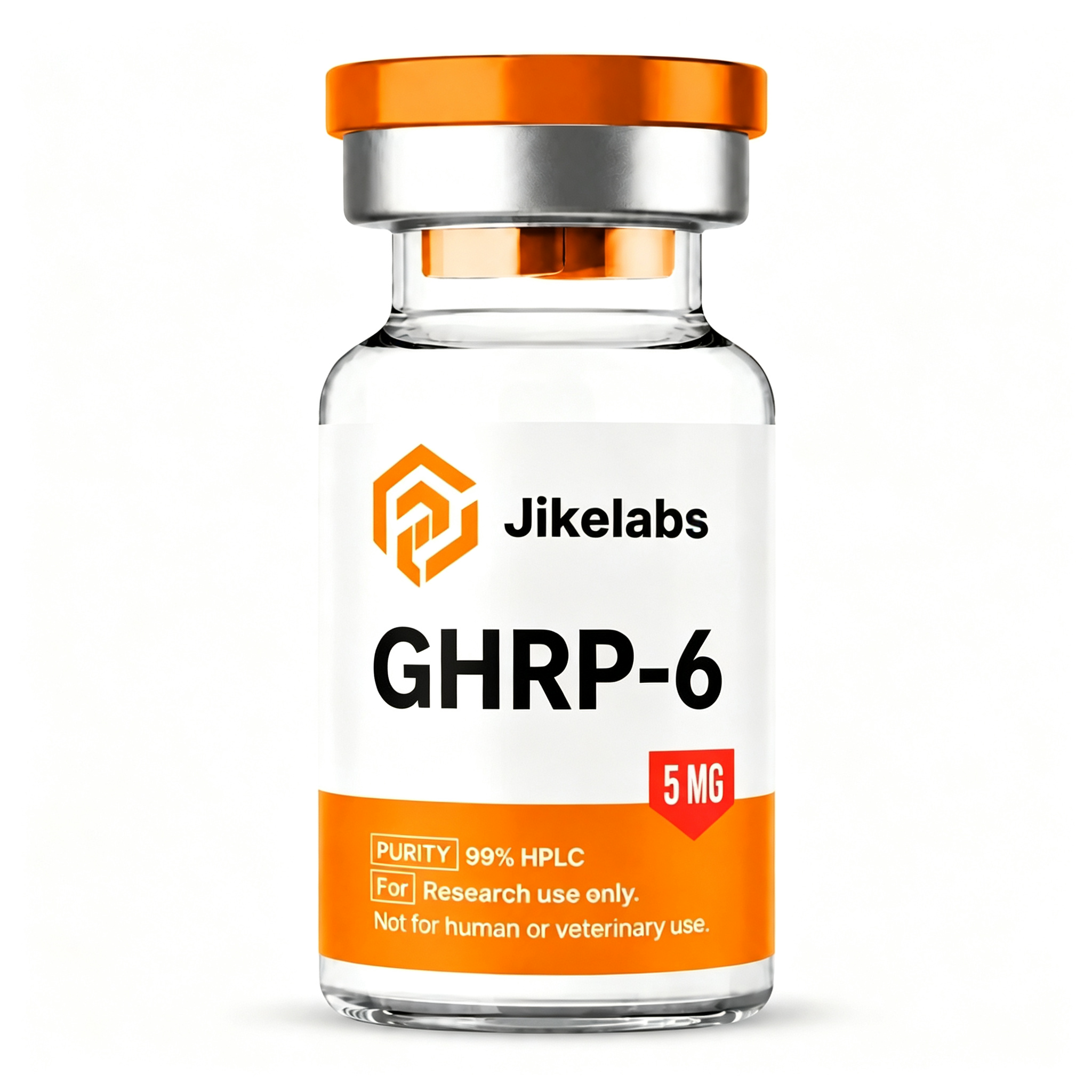
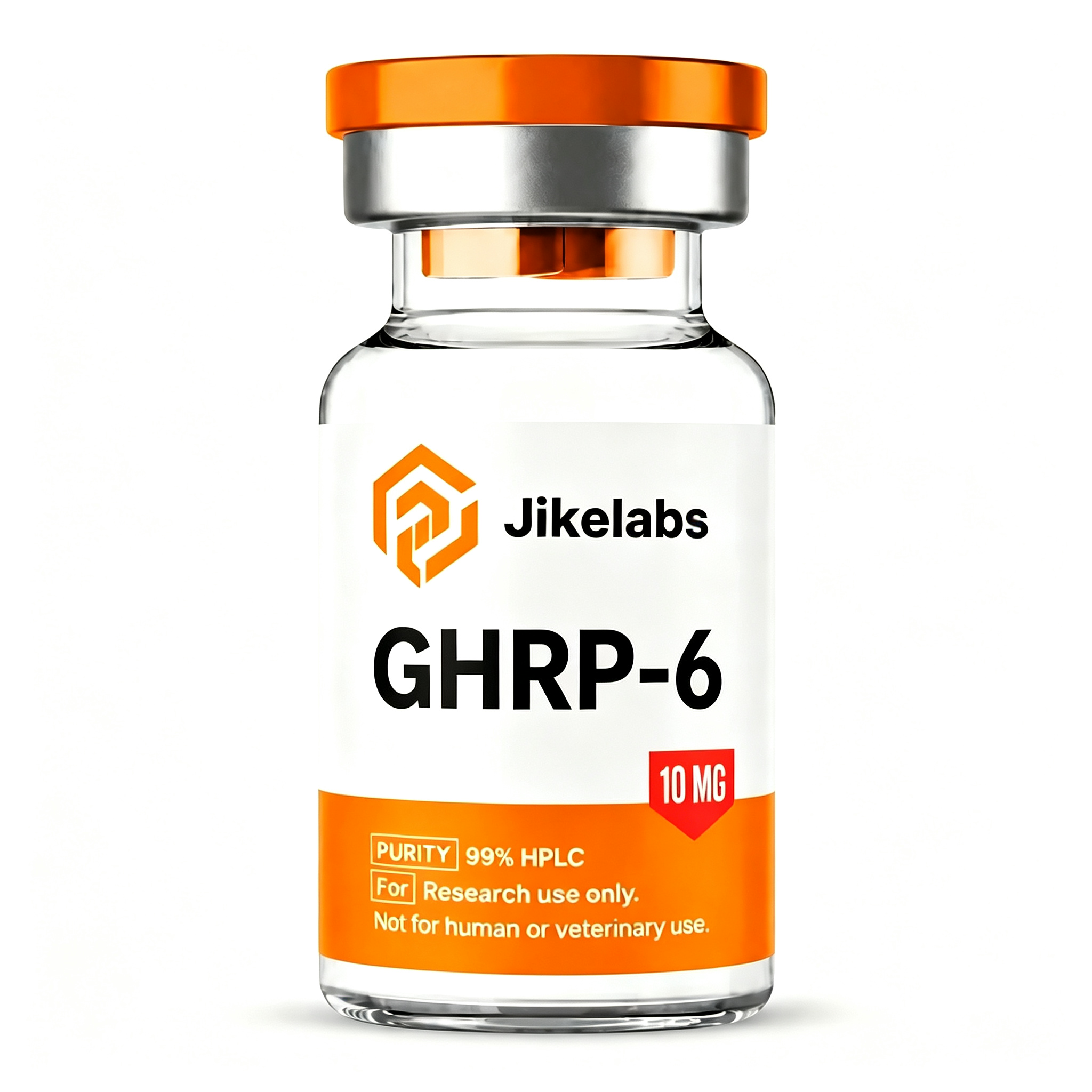
GHRP-6 5MG 10MG
-
Detail
GHRP-6 5mg
The First-in-Human Ghrelin-Mimetic Hexapeptide | Foundational GHRP Family Research Tool
His-D-Trp-Ala-Trp-D-Phe-Lys-NH₂ · SK&F 110679 Lineage · Research Use Only
🏛 The Original GHRP
The founding compound of the entire growth-hormone-releasing peptide class — first hexapeptide shown to stimulate GH release in humans (1991).
🍽 Strongest Appetite Signal
Produces the most prominent appetite stimulation of the GHRP family — a key property for ghrelin-pathway feeding research.
🧬 Antagonist Scaffold
The structural basis of D-Lys³-GHRP-6 — the standard ghrelin-receptor antagonist used in receptor-validation studies worldwide.
🧊 D-Residue Stability
D-Trp and D-Phe at positions 2 and 5 confer resistance to proteolytic degradation in research models.
Product Overview
GHRP-6 (Growth Hormone Releasing Peptide-6) is a synthetic hexapeptide with the sequence His-D-Trp-Ala-Trp-D-Phe-Lys-NH₂. It is the founding member of the GHRP family — a class of non-natural peptides with no structural homology to GHRH that potently stimulate somatotrope growth-hormone secretion via a specific receptor later identified as the ghrelin receptor GHS-R1a.
GHRP-6 holds a unique place in endocrine-research history: it was the first GH-releasing peptide administered to humans, demonstrating dose-dependent GH release in healthy volunteers (1991) and synergistic action with GHRH. As a ghrelin mimetic, it also produces the strongest appetite stimulation in the GHRP family and activates the hypothalamo-pituitary-adrenal axis — properties that make it both a powerful secretagogue and a canonical tool for studying ghrelin-receptor biology, feeding circuits and HPA-axis crosstalk.
Each vial contains 5mg of high-purity GHRP-6 as a white to off-white lyophilized powder, supplied strictly for in-vitro and laboratory research use only.
Specifications
Product Name GHRP-6 Synonyms GHRP · Growth Hormone Releasing Hexapeptide · His-D-Trp-Ala-Trp-D-Phe-Lys-NH₂ CAS Number 87616-84-0 Amino Acid Sequence His-D-Trp-Ala-Trp-D-Phe-Lys-NH₂ (6 residues, C-terminally amidated; single-letter HwAWfK-NH₂) Molecular Formula C46H56N12O6 Molecular Weight ≈ 873.0 g/mol Net Content 5 mg / vial Appearance White to off-white lyophilized powder Purity ≥ 98% (by HPLC) Solubility Soluble in water / aqueous buffer Storage Store lyophilized at -20°C, protected from light and moisture; refrigerate after reconstitution and use promptly Historical Position: Where the GHRP Family Began
🔬 1980s discovery — The GHRP series emerged from systematic synthetic-peptide screening; GHRP-6 (SK&F 110679 lineage) became the definitive hexapeptide of the class.
🧑⚕️ 1991 first-in-human milestone — GHRP was the first synthetic non-GHRH peptide shown to stimulate GH release in healthy men, and to act synergistically with GHRH — a result that opened the secretagogue field and ultimately led to identification of the ghrelin receptor (GHS-R1a, cloned 1996) and ghrelin itself (1999).
🧪 Scaffold for pharmacological tools — the GHRP-6 sequence was subsequently modified to create D-Lys³-GHRP-6, the standard ghrelin-receptor antagonist used worldwide to validate GHS-R1a dependence in receptor and behavioral studies.
🌳 Descendants — later GHRPs (GHRP-2, hexarelin, ipamorelin) were developed by modifying this scaffold for potency or selectivity — making GHRP-6 the reference ancestor of the whole family.
Mechanism of Action
Step What Happens 1. GHS-R1a Binding GHRP-6 binds the ghrelin / growth-hormone-secretagogue receptor 1a (GHS-R1a) at pituitary and hypothalamic levels — the receptor later shown to be activated by endogenous ghrelin. 2. GH Secretion Somatotrophs release GH in robust, dose-dependent pulses; GHRP-6 acts synergistically with GHRH, exceeding the response to either compound alone. 3. Appetite Stimulation As a ghrelin mimetic, GHRP-6 produces the strongest food-intake stimulation of the GHRP family in animal models — a canonical phenotype for feeding-circuit research. 4. HPA & Prolactin Activation GHRP-6 activates the hypothalamo-pituitary-adrenal axis — raising ACTH and cortisol — and elevates prolactin, mirroring ghrelin's full signaling profile. These co-stimulatory effects define first-generation GHRPs and distinguish them from selective agonists like ipamorelin. GHRP-6 vs GHRP-2 vs Ipamorelin
Aspect GHRP-6 (this product) GHRP-2 Ipamorelin Sequence His-D-Trp-Ala-Trp-D-Phe-Lys-NH₂ D-Ala-D-2-Nal-Ala-Trp-D-Phe-Lys-NH₂ Aib-His-D-2-Nal-D-Phe-Lys-NH₂ Family Position Founding member; first-in-human GHRP (1991) Potency reference (pralmorelin) Selectivity benchmark Appetite Stimulation Strongest in the family Strong Markedly weaker Cortisol / ACTH / Prolactin Elevated (ghrelin-like full profile) Elevated at higher doses No significant elevation Typical Research Use Feeding-circuit and GHS-R biology; antagonist-scaffold reference Peak-GH potency studies; diagnostic lineage Clean GH-axis protocols; dual-pathway blends Research Highlights
📖 First-in-Human GH Stimulation (1991)
The GH-releasing hexapeptide stimulated GH release in normal men and acted synergistically with GH-releasing hormone — the study that opened the secretagogue era (PubMed: 2108187).
📖 Mallo et al., 1993 — Regulation Studies
In-vivo GH responses to GHRP-6 characterized under controlled conditions, defining dose-response and regulation of the secretagogue response.
📖 Ghrelin-Mimetic Feeding Effect
GHRP-6 stimulates eating and food intake through ghrelin-receptor pathways; its appetite effect is consistently described as the most prominent in the research peptide space, stronger than ipamorelin or GHRP-2.
📖 D-Lys³-GHRP-6 Antagonist Legacy
Derivatives of the GHRP-6 scaffold (notably D-Lys³-GHRP-6) became the standard ghrelin-receptor antagonists, used to confirm receptor dependence in countless GHS-R1a studies — a testament to the scaffold's central role in ghrelin biology.
Research Applications & Compliance Notes
🍽 Feeding-circuit research — ghrelin-mimetic appetite stimulation, food-intake behavioral paradigms, satiety-pathway studies. 🧬 GHS-R1a receptor pharmacology — agonist characterization, antagonist validation (with D-Lys³-GHRP-6), and receptor-dependence controls. ⚡ HPA-axis crosstalk studies — cortisol/ACTH and prolactin co-stimulation readouts versus selective agonists. 📐 GH-secretagogue structure-activity studies — hexapeptide scaffold modifications across the GHRP family. Compliance note: GHRP-6 and related secretagogues fall under peptide hormones / growth factors on the WADA Prohibited List (category S2), and are established detection targets in doping control. Buyers conducting sports-related research should factor this in.
Reconstitution & Handling
💧 Add sterile or bacteriostatic water slowly down the side of the vial; swirl gently until fully dissolved — do not shake vigorously. 🧪 Aliquot reconstituted solution to avoid repeated freeze-thaw cycles; label each aliquot with batch, concentration and preparation date. 🧊 Lyophilized powder: store frozen (-20°C), protected from light and moisture; reconstituted solution: refrigerate and use within your validated stability window. ⚖️ Handle with aseptic technique and appropriate PPE per your laboratory SOP. Quality Assurance
✔ Lot-specific Certificate of Analysis: HPLC purity confirmation + mass-spectrometry identity verification (expected intact mass ≈ 873 Da for the amidated hexapeptide; confirm salt form per your batch documentation).
✔ Third-party batch testing documentation available upon request.
References & Further Reading
- Bowers CY, et al. Growth hormone (GH)-releasing peptide stimulates GH release in normal men and acts synergistically with GH-releasing hormone. PubMed: 2108187. 1991.
- Mallo F, et al. Regulation of His-D-Trp-Ala-Trp-D-Phe-Lys-NH₂ (GHRP-6)-induced GH secretion. PubMed: 8510800. 1993.
- Petersenn S, et al. Growth hormone-releasing peptides — structure and kinetics. J Pediatr Endocrinol Metab. 1993. (First three GHRPs administered to humans: GHRP-6, GHRP-1, GHRP-2)
- Lengyel AMJ. Novel aspects of growth hormone-releasing peptides and ghrelin. Braz J Med Biol Res. 2006.
- GHRP-6 — ChemicalBook CB8421540 (CAS 87616-84-0, C₄₆H₅₆N₁₂O₆, MW 873.02).
Disclaimer: This product is intended exclusively for in-vitro laboratory research use. It is not approved for human or animal use, is not a drug, food, cosmetic, or dietary supplement, and is not intended to diagnose, treat, cure or prevent any disease. All products are supplied strictly for research purposes only. -
Customer ReviewsNo comments