
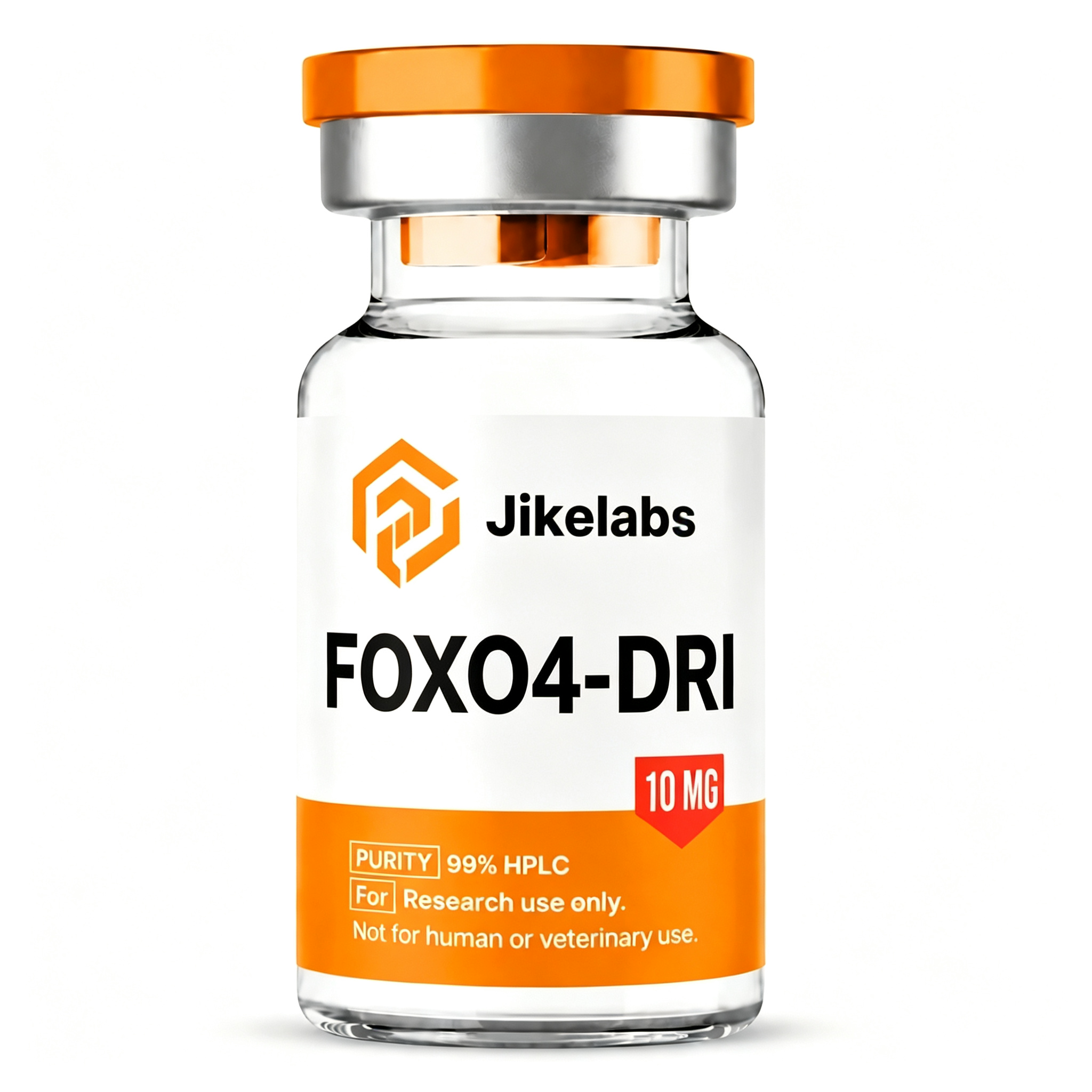
FOX04-DRI 10mg*10vials
-
Detail
FOXO4-DRI 10mg
Senolytic Peptide | FOXO4–p53 Interaction Blocker for Targeted Senescent-Cell Clearance
D-Retro-Inverso Design · DRI = D-Arginine Inversion · Research Use Only
🎯 Senolytic Precision
Induces targeted apoptosis of senescent cells (TASC) while sparing healthy cells — the defining selectivity of the FOXO4–p53 axis.
📖 Cell 2017 Heritage
Published by Baar et al. in Cell (2017, 1600+ citations) — a landmark paper in the senolytics field.
🧬 DRI Stability
D-retro-inverso construction from D-amino acids confers strong resistance to proteolytic degradation.
⏳ In-Vivo Fitness Data
Restored fitness, fur density and renal function in both fast-aging and naturally aged mice in the original study.
Product Overview
FOXO4-DRI is a senolytic peptide developed by de Keizer and colleagues at Erasmus University Medical Center and reported in a landmark 2017 Cell paper. It is a D-retro-inverso peptide modeled on the p53-binding interface of the transcription factor FOXO4, built from D-amino acids in reversed sequence order — a design that preserves the binding geometry while providing exceptional resistance to proteases.
The scientific premise: senescent cells resist apoptosis in part because FOXO4 sequesters p53 in the nucleus, preventing p53 from triggering cell death. FOXO4-DRI disrupts this FOXO4–p53 interaction, releasing p53 and inducing targeted apoptosis of senescent cells (TASC) — while healthy cells, which do not depend on the FOXO4–p53 survival axis, are spared. In the original study, a single course of treatment restored fitness, fur density, and renal function in both fast-aging and naturally aged mice.
Each vial contains 10mg of high-purity FOXO4-DRI as a lyophilized powder, supplied strictly for in-vitro and laboratory research use only.
Specifications
Product Name FOXO4-DRI Synonyms FOXO4 D-Retro-Inverso Peptide · FOXO4/p53 Interaction Blocker · Senolytic FOXO4 Peptide CAS Number 2460055-10-9 Design D-retro-inverso peptide modeled on the FOXO4 p53-binding interface (all-D amino acids, reversed sequence direction) Molecular Formula C228H388N86O64 Molecular Weight ≈ 5358.1 g/mol Net Content 10 mg / vial Appearance White to off-white lyophilized powder Purity ≥ 98% (by HPLC) Solubility Soluble in water / aqueous buffer Storage Store lyophilized at -20°C, protected from light and moisture; refrigerate after reconstitution and use promptly Why D-Retro-Inverso? The DRI Design
🪞 Retro-inverso logic — a D-retro-inverso peptide uses D-amino acids in reversed sequence order relative to the natural L-peptide. This preserves the side-chain topology (and thus the binding surface) while inverting the backbone direction.
🛡 Protease resistance — cellular proteases evolved to cleave L-amino-acid peptide bonds. An all-D backbone is largely invisible to them, giving the peptide exceptional metabolic stability for in-vivo research models.
🎯 Binding geometry retained — despite the inversion, the side-chain display remains sufficiently similar to the native FOXO4 interface to compete for p53 binding, which is the entire therapeutic logic of the molecule.
Mechanism of Action
Step What Happens 1. The Senescent-Cell Survival Lock In senescent cells, FOXO4 binds and sequesters p53 in the nucleus, blocking p53-mediated apoptosis — one reason senescent cells accumulate instead of dying (the "senescence stem lock" concept). 2. Competitive Disruption FOXO4-DRI binds the p53 interaction surface, displacing native FOXO4 and breaking the FOXO4–p53 complex. 3. p53 Release Freed p53 regains access to its apoptotic transcriptional program in senescent cells. 4. Targeted Apoptosis Senescent cells undergo apoptosis (TASC — Targeted Apoptosis of Senescent Cells); healthy cells, which do not depend on FOXO4-mediated p53 sequestration, are spared. Research Highlights
📖 Baar et al., 2017 (Cell, 1600+ citations)
Targeted Apoptosis of Senescent Cells Restores Tissue Homeostasis in Response to Chemotoxicity and Aging: the FOXO4 peptide induced targeted apoptosis of senescent cells and restored fitness, fur density, and renal function in both fast-aging and naturally aged mice.
📖 Selectivity Benchmark
The de Keizer group reported greater than 10-fold selectivity for senescent over healthy cells in the discovery phase (Nature Reviews Nephrology, 2017) — before in-vivo translation.
📖 Ongoing Field Development
Molecular modeling of the FOXO4–TP53 interface (Le et al., 2021) and biophysical studies of the disordered p53 transactivation domain (Bourgeois et al., 2025, Nature Communications) continue to refine this target class — making FOXO4-DRI a reference tool compound in senotherapeutics research.
Research Applications & Evidence Status
🧬 Senolytic screening — positive control for targeted senescent-cell apoptosis assays. 🔬 FOXO4–p53 protein-protein interaction studies — binding, competition and interface-mutation experiments. ⏳ Aging and senescence biology — cellular senescence markers, SASP readouts, tissue-homeostasis models. 🧪 Peptide-design studies — D-retro-inverso stability comparisons and next-generation senolytic analog development. 📋 Evidence Status: FOXO4-DRI's senolytic activity is documented in cell cultures (senescent human cell models) and mouse models from the 2017 Cell study and follow-up work. It remains a research compound — no approved human therapy exists for this peptide, and findings cited above do not imply human efficacy.Reconstitution & Handling
💧 Add sterile or analytical-grade water slowly down the side of the vial; swirl gently until fully dissolved — do not shake vigorously. 🧪 Aliquot reconstituted solution to avoid repeated freeze-thaw cycles; label each aliquot with batch, concentration and preparation date. 🧊 Lyophilized powder: store frozen (-20°C), protected from light and moisture; reconstituted solution: refrigerate and use within your validated stability window. ⚖️ Handle with aseptic technique and appropriate PPE per your laboratory SOP. Quality Assurance
✔ Lot-specific Certificate of Analysis: HPLC purity confirmation + mass-spectrometry identity verification (expected intact mass ≈ 5358 Da; confirm the all-D configuration per your batch documentation).
✔ Third-party batch testing documentation available upon request.
References & Further Reading
- Baar MP, Brandt RMC, Putavet DA, et al. Targeted Apoptosis of Senescent Cells Restores Tissue Homeostasis in Response to Chemotoxicity and Aging. Cell. 2017;169(1):132-147.e16. (Cited 1600+)
- Targeting senescence-associated tissue damage. Nature Reviews Nephrology. 2017. (de Keizer interview: >10-fold selectivity quote)
- Le HH, et al. Molecular modelling of the FOXO4-TP53 interaction to design senolytic peptides. PMC8546421. 2021.
- Bourgeois B, et al. The disordered p53 transactivation domain is the target of the senolytic peptide FOXO4-DRI. Nat Commun. 2025.
- FOXO4-DRI — Wikipedia / PubChem CID 167312269 (CAS 2460055-10-9, C₂₂₈H₃₈₈N₈₆O₆₄, MW 5358.15).
Disclaimer: This product is intended exclusively for in-vitro laboratory research use. It is not approved for human or animal use, is not a drug, food, cosmetic, or dietary supplement, and is not intended to diagnose, treat, cure or prevent any disease. Senolytic findings cited above are from published cell-culture and animal-model research and do not constitute efficacy claims for any commercial product. All products are supplied strictly for research purposes only. -
Customer ReviewsNo comments