
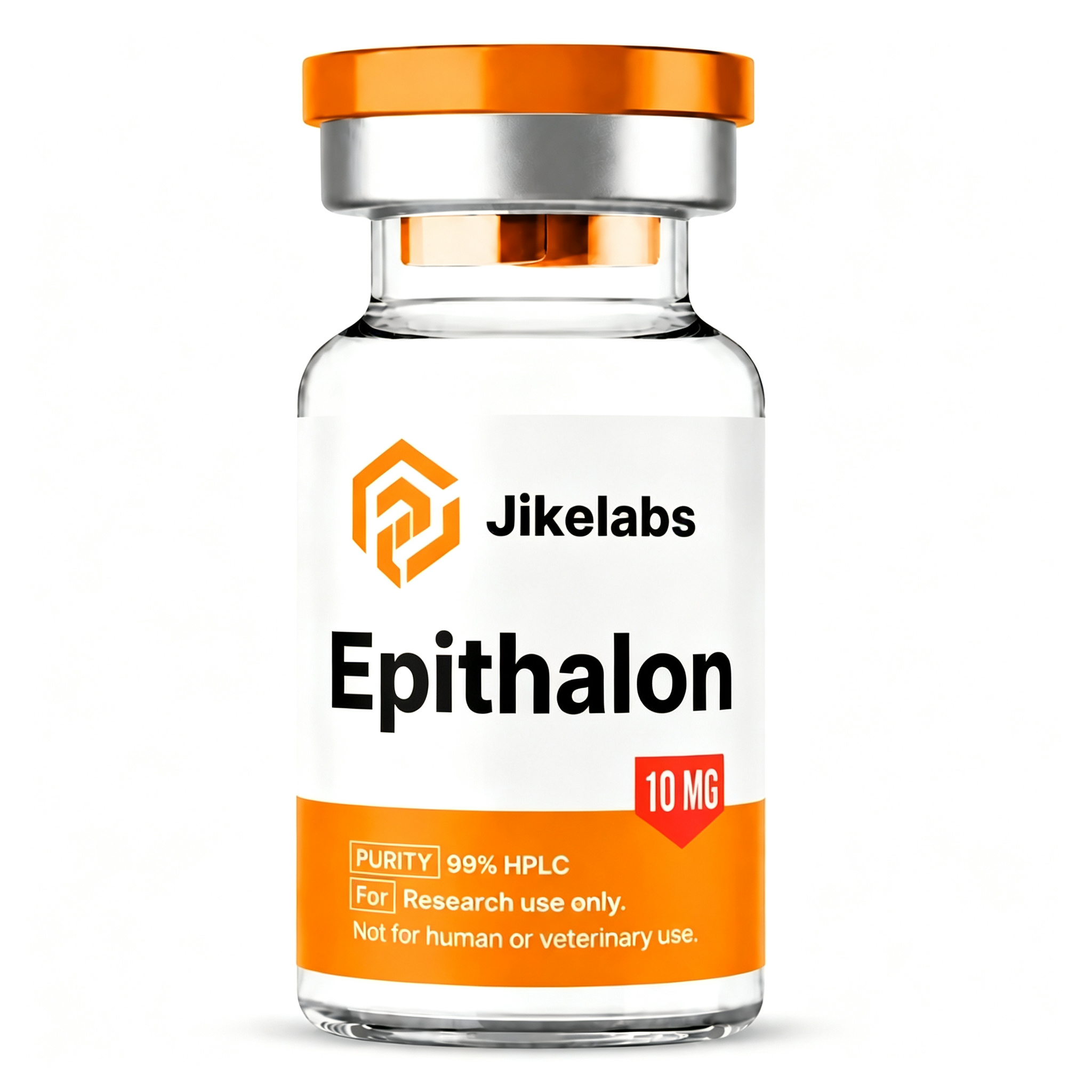
Epithalon 10MG 50MG
-
Detail
Epithalon 10mg (Epitalon / AEDG)
Pineal Bioregulator Tetrapeptide | Telomerase-Activating Longevity Research Peptide
Ala-Glu-Asp-Gly · Synthetic Analog of Pineal Epithalamin · Research Use Only
🧬 Telomerase Signature
Upregulates hTERT expression and induces telomerase activity, lengthening telomeres in cultured human cells — its defining longevity mechanism.
🌲 Pineal Lineage
A synthetic tetrapeptide derived from epithalamin, the pineal-gland polypeptide bioregulator studied by Khavinson since the 1970s.
🌙 Rhythm & Melatonin
Reported to influence melatonin synthesis and help restore circadian rhythms of melatonin and cortisol in animal models.
🧊 Small & Stable
A compact 390 Da tetrapeptide — highly stable, water-soluble, and easy to handle as a lyophilized powder.
Product Overview
Epithalon (also written Epitalon, and known as the AEDG peptide after its amino-acid sequence Ala-Glu-Asp-Gly) is a synthetic tetrapeptide and a telomerase activator studied in aging and longevity research. It was developed as a standardized synthetic analog of epithalamin, a polypeptide extract of the pineal gland first isolated by Professor Vladimir Khavinson and colleagues at the St. Petersburg Institute of Bioregulation and Gerontology.
The compound's signature mechanism is the upregulation of the telomerase reverse-transcriptase gene (hTERT), inducing telomerase activity that extends telomere length in human cell cultures and supports the replicative potential of cells. Beyond telomere biology, Epithalon is studied for its influence on pineal-gland function, melatonin synthesis, circadian-rhythm regulation, and epigenetic aspects of gene expression.
Each vial contains 10mg of high-purity Epithalon as a white to off-white lyophilized powder, supplied strictly for in-vitro and laboratory research use only.
Specifications
Product Name Epithalon (Epitalon) Synonyms AEDG Peptide · Epithalon Tetrapeptide · Synthetic Pineal Bioregulator CAS Number 307297-39-8 Amino Acid Sequence Ala-Glu-Asp-Gly (AEDG, 4 residues) Molecular Formula C14H22N4O9 Molecular Weight 390.35 g/mol Origin Synthetic analog of epithalamin (bovine pineal-gland polypeptide extract); supplied as defined synthetic tetrapeptide Net Content 10 mg / vial Appearance White to off-white lyophilized powder Purity ≥ 99% (by HPLC) Solubility Soluble in water / aqueous buffer (also soluble in DMSO) Storage Store lyophilized at -20°C, protected from light and moisture; refrigerate after reconstitution and use promptly Origin: The Khavinson Pineal Bioregulator
🌲 The epithalamin story — In the 1970s, Professor Vladimir Khavinson began isolating organ-specific polypeptide extracts (bioregulators). From the pineal gland he derived epithalamin, which became the foundation for decades of pineal-peptide research.
🧪 From extract to defined peptide — To obtain a reproducible, well-characterized molecule, Khavinson's group identified the short peptide responsible for activity and synthesized it: the tetrapeptide Ala-Glu-Asp-Gly, sold as Epitalon. This move from a heterogeneous glandular extract to a single defined sequence is what makes Epithalon a practical research reagent.
🧬 Part of a larger family — Epithalon sits within Khavinson's bioregulator system alongside other short peptides (such as the pineal-related Epithalone and the immune peptide Vilon), a lineage frequently referenced in regenerative and longevity research.
Mechanism & Researched Pathways
🧬 Telomerase activation — upregulates hTERT mRNA expression and induces telomerase activity, producing dose-dependent telomere elongation in human fibroblast and cell-line cultures. 🌙 Pineal & melatonin regulation — influences pineal-gland function and melatonin synthesis, with reports of restored circadian rhythms of melatonin and cortisol in animal models. 🧠 Neurogenesis & epigenetics — stimulates gene expression and protein synthesis during neurogenesis, with a possible epigenetic mechanism (Khavinson et al., 2020). 🛡 Immune & antioxidant readouts — studied for modulation of interleukin-2 levels and antioxidant defenses in aging models. ⏳ Lifespan models — reported to extend lifespan in fruit-fly and murine models, and to influence telomere length and aging biomarkers in aged laboratory primates. Research Highlights
📖 Khavinson et al., 2020 (Molecules)
The AEDG peptide (Epitalon) stimulates gene expression and protein synthesis during neurogenesis, pointing to a possible epigenetic mechanism of action.
📖 Al-Dulaimi et al., 2025 (Biogerontology)
Epitalon increases telomere length in human cell lines through telomerase upregulation or ALT-associated activity — direct in-vitro support for its telomere-biology mechanism.
📖 Araj et al., 2025 — Overview of Epitalon
A widely cited review characterizing Epitalon as a highly bioactive pineal tetrapeptide, summarizing its effects on melatonin synthesis, interleukin-2 levels, and age-related pathways.
📋 Evidence Status Note
Epithalon's telomerase and longevity effects are documented primarily in cell cultures, animal models (flies, mice, primates), and observational human data from Khavinson's group. Robust large-scale randomized human trials remain limited. We present this evidence hierarchy transparently so researchers can evaluate the compound appropriately for their own study designs.
Research Applications
🧬 Telomere & cellular-aging research — telomerase activity, hTERT expression, and telomere-length readouts. 🌙 Pineal-gland / circadian research — melatonin synthesis and rhythm-regulation studies. 🧠 Neurogenesis & epigenetic gene-expression assays. 🛡 Immunomodulation & antioxidant-defense studies in aging models. 📊 Bioregulator-peptide comparison studies within the Khavinson short-peptide family. Reconstitution & Handling
💧 Add sterile or analytical-grade water slowly down the side of the vial; swirl gently until fully dissolved — do not shake vigorously. 🧪 Aliquot reconstituted solution to avoid repeated freeze-thaw cycles; label each aliquot with batch, concentration and preparation date. 🧊 Lyophilized powder: store frozen (-20°C), protected from light and moisture; reconstituted solution: refrigerate and use within your validated stability window. 【请核实】 ⚖️ Handle with aseptic technique and appropriate PPE per your laboratory SOP. Quality Assurance
✔ Lot-specific Certificate of Analysis: HPLC purity confirmation + mass-spectrometry identity verification (expected [M+H]⁺ consistent with the tetrapeptide mass of 390.35).
✔ Third-party batch testing documentation available upon request.
References & Further Reading
- Khavinson V, et al. AEDG Peptide (Epitalon) Stimulates Gene Expression and Protein Synthesis during Neurogenesis: Possible Epigenetic Mechanism. Molecules. 2020;25(3):609.
- Al-Dulaimi S, et al. Epitalon increases telomere length in human cell lines through telomerase upregulation or ALT activity. Biogerontology. 2025.
- Araj SK, et al. Overview of Epitalon — Highly Bioactive Pineal Tetrapeptide. PMC11943447. 2025.
- Effects of short peptides on the molecular mechanisms of aging in laboratory primates. Eco-Vector J. 2025.
- Epitalon — PubChem CID 219042 / Inxight Drugs (CAS 307297-39-8, C₁₄H₂₂N₄O₉, MW 390.35).
Disclaimer: This product is intended exclusively for in-vitro laboratory research use. It is not approved for human or animal use, is not a drug, food, cosmetic, or dietary supplement, and is not intended to diagnose, treat, cure or prevent any disease. Telomerase and longevity findings cited above are from published cell-culture, animal-model and observational research and do not constitute efficacy claims for any commercial product. All products are supplied strictly for research purposes only. -
Customer ReviewsNo comments