
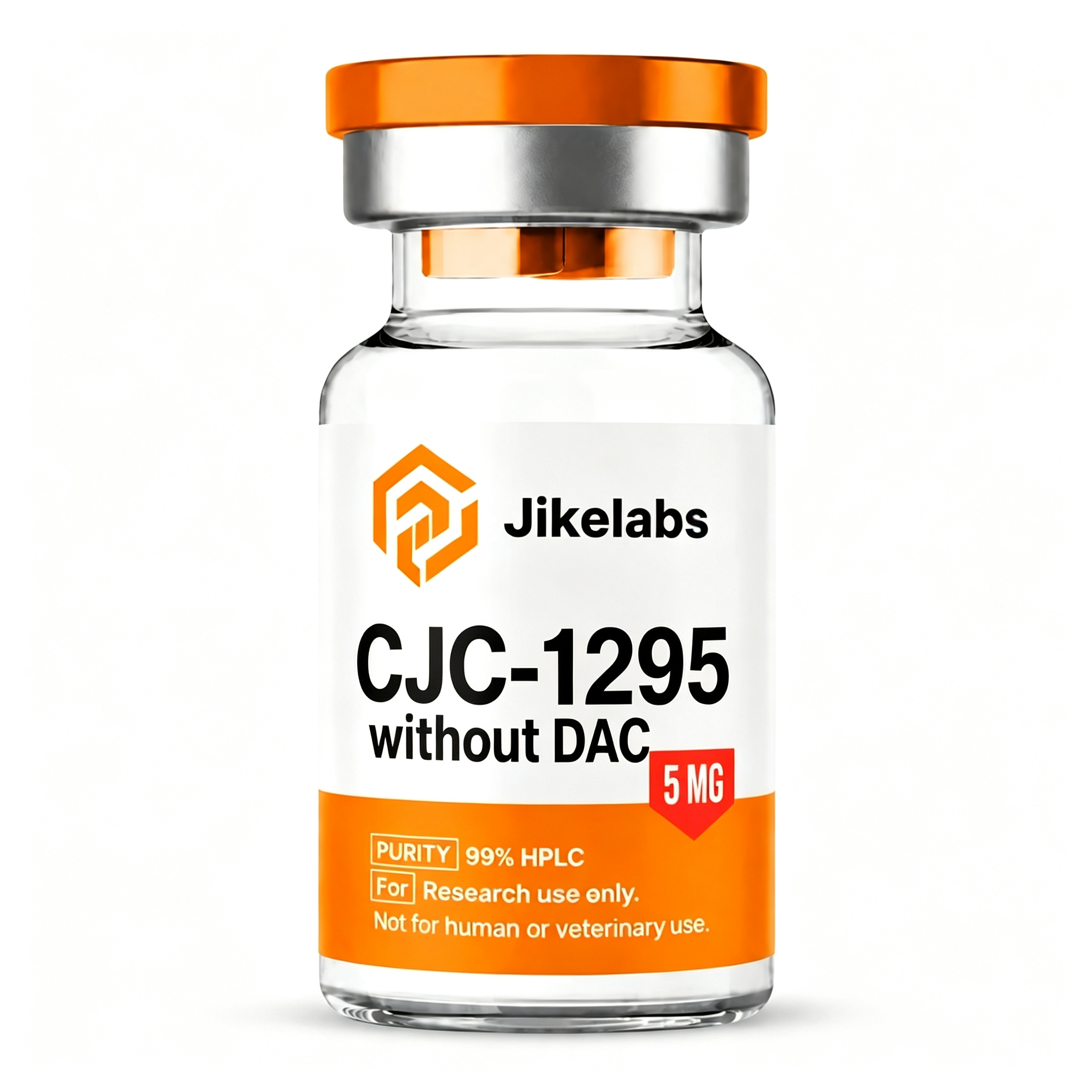
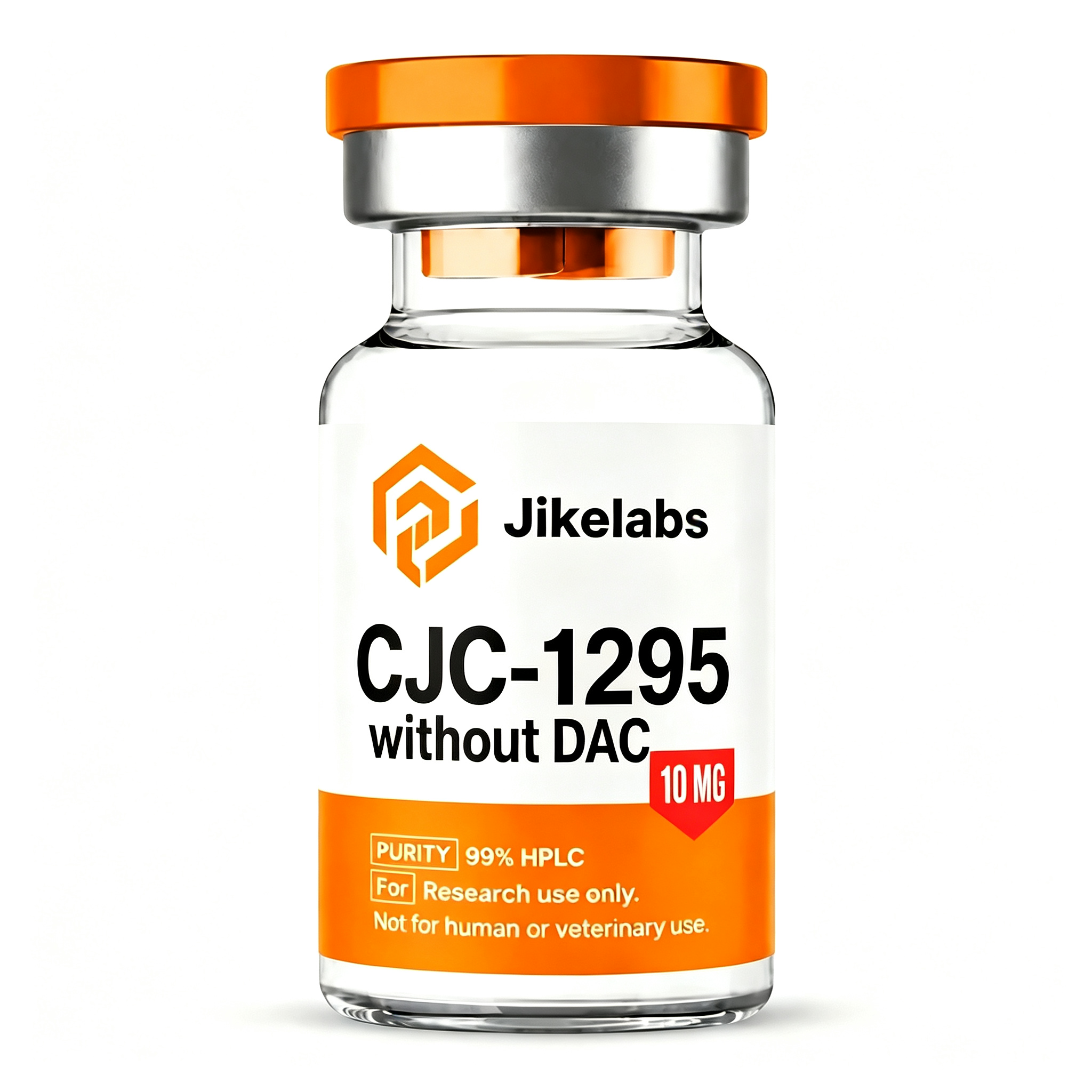
CJC-1295 without DAC 5MG 10MG
-
Detail
CJC-1295 without DAC 5mg
Modified GRF (1-29) | Short-Acting, Pulse-Preserving GHRH Analog
Tetra-Substituted GHRH(1-29)-NH₂ · No Albumin-Binding Linker · Research Use Only
⚡ Discrete GH Pulses
Short-acting profile produces distinct growth-hormone pulses per administration — a clean model of pulsatile GH-axis stimulation.
🛡 DPP-IV Resistant
Four stabilizing substitutions protect against enzymatic cleavage, extending activity from minutes to roughly 20–30 minutes.
🤝 Classic Ipamorelin Pairing
The go-to research partner of ipamorelin — GHRH and ghrelin-receptor pathways combined for dual-pathway growth-axis designs.
🧊 Clean Pharmacokinetics
No albumin-binding linker — rapid, predictable clearance makes exposure timing easy to control in protocol design.
Product Overview
CJC-1295 without DAC — more precisely called Modified GRF (1-29) or Mod GRF 1-29 — is a synthetic 29-amino-acid analog of growth hormone-releasing hormone (GHRH) with a C-terminal amide. It carries four stabilizing substitutions at positions 2, 8, 15 and 27 that dramatically improve resistance to enzymatic degradation, but without the albumin-binding Drug Affinity Complex (DAC) linker of its long-acting sibling.
Native GHRH is cleared within about 7 minutes by rapid DPP-IV cleavage. Modified GRF (1-29) resists this degradation, reaching a functional half-life of approximately 20–30 minutes — long enough to drive a robust, discrete pulse of pituitary growth-hormone release, yet short enough to clear before the next exposure. This pulsatile profile is precisely why researchers choose the No-DAC form when studying physiological GH-pulse patterns, in contrast to the sustained 6–8-day axis engagement of the DAC form.
Each vial contains 5mg of high-purity Modified GRF (1-29) as a lyophilized powder, supplied for research use only.
Specifications
Product Name CJC-1295 without DAC (Modified GRF 1-29) Synonyms Modified GRF (1-29) · Mod GRF 1-29 · Tetra-Substituted GRF(1-29) · GHRH(1-29)-NH₂ analog CAS Number 863288-34-0 Amino Acid Sequence 29-residue GHRH(1-29) analog, C-terminally amidated, with four stabilizing substitutions: D-Ala2, Aib8, D-Ala15, Gly27-NH₂ (replacing the native C-terminal tail) Molecular Formula C152H252N44O42 Molecular Weight 3367.9 g/mol Half-Life (Published Data) ≈ 20–30 minutes (vs ≈ 7 minutes for native GHRH) Net Content 5 mg / vial Appearance White to off-white lyophilized powder Purity ≥ 99% (by HPLC) Solubility Soluble in water / aqueous buffer Storage Store at 2–8°C; for long-term storage, freeze and protect from light and moisture What the Four Substitutions Do
Native GHRH is rapidly destroyed by DPP-IV cleavage at the Ala2-Asp3 bond, limiting its plasma half-life to roughly 7 minutes. Modified GRF (1-29) solves this with four targeted changes:
✔ D-Ala2 — replaces the DPP-IV cleavage site; human data show this single change lowers metabolic clearance and extends disappearance half-life (from ≈4.3 to ≈6.7 min alone, far more when combined).
✔ Aib8 (α-aminoisobutyric acid) — a non-natural amino acid that further blocks enzymatic attack mid-chain.
✔ D-Ala15 — adds additional protease resistance at the C-terminal half.
✔ Gly27-NH₂ — replaces the native C-terminal tail (Asp27-Ile28-Met29-Ser29) with a stabilized amidated terminus, improving receptor binding and stability. Together, the four substitutions raise the functional half-life to ≈ 20–30 minutes while preserving high-affinity GHRH-receptor agonism.
Mechanism of Action
Step What Happens 1. GHRH-Receptor Binding The GRF(1-29) core binds GHRH receptors on pituitary somatotroph cells with high affinity — the same receptor targeted by native GHRH. 2. Endogenous GH Release Pituitary growth-hormone synthesis and secretion are stimulated through the body's own axis, producing a discrete GH pulse per exposure. 3. Pulse-Preserving Profile With a ≈20–30 min half-life and no albumin depot, each administration resolves cleanly — mimicking the pulsatile rhythm of physiological GH secretion. 4. Downstream IGF-1 Axis Repeated pulsatile stimulation drives hepatic IGF-1 output in research models, supporting growth-axis endpoint readouts. No DAC vs With DAC: Two Distinct Products
Aspect CJC-1295 without DAC (this product) CJC-1295 with DAC Core Sequence GRF(1-29) analog with four stabilizing substitutions Same core sequence Albumin-Binding DAC None Yes — covalent albumin conjugation Half-Life (Published Data) ≈ 20–30 minutes ≈ 6–8 days GH Release Pattern Discrete pulses per administration — physiological rhythm Sustained low-level axis engagement for days Best Suited For Pulsatile GH-axis research, ipamorelin combination studies Infrequent-dosing and sustained-exposure designs Research Highlights
📖 D-Ala2 Human PK Data
Clinical pharmacokinetic work on the D-Ala2 GHRH(1-29) substitution showed lowered metabolic clearance (39.7 → 21 mL/kg/min) and extended disappearance half-life (4.3 → 6.7 minutes) in humans — the foundational evidence that stacking stabilizing substitutions extends GHRH activity.
📖 Sermorelin Lineage
Modified GRF (1-29) descends from the same GHRH(1-29) analog family as sermorelin — the long-established diagnostic and research tool for pituitary GH-reserve testing.
📖 The Ipamorelin Combination Literature
GHRH-analog + ghrelin-receptor-agonist pairings are among the most referenced designs in growth-axis research: complementary pathways (hypothalamic GHRH-receptor and ghrelin/GHS-R) converge on somatotroph GH release, with published accounts describing amplified GH peaks versus either compound alone.
Research Applications & Compliance Notes
🧬 Growth-hormone-axis pharmacology — GHRH-receptor activation and pulsatile GH-secretion studies. ⏱ Short-acting vs long-acting secretagogue comparisons (paired with CJC-1295 with DAC). 🤝 Dual-pathway designs with ipamorelin (GHRH + GHS-R agonism). 🧪 Structure-activity studies of GHRH analog substitutions (D-Ala2, Aib8, D-Ala15, Gly27-NH₂). Compliance note: CJC-1295 (both forms) is prohibited by WADA as a growth-hormone-releasing substance, and is listed on doping-control prohibited lists in multiple jurisdictions. Buyers conducting sports-related research should factor this in.
Reconstitution & Handling
💧 Add sterile or bacteriostatic water slowly down the side of the vial; swirl gently until fully dissolved — do not shake vigorously. 🧪 Aliquot reconstituted solution to avoid repeated freeze-thaw cycles. 🧊 Lyophilized powder: store frozen (-20°C), protected from light and moisture; reconstituted solution: refrigerate and use within your validated stability window. ⚖️ Handle with aseptic technique and appropriate PPE per your laboratory SOP. Quality Assurance
✔ Lot-specific Certificate of Analysis: HPLC purity confirmation + mass-spectrometry identity verification (confirming the tetra-substituted sequence and C-terminal amide).
✔ Third-party batch testing documentation available upon request.
References & Further Reading
- Wikipedia / PubChem CID 91976842 — CJC1295 Without DAC: molecular formula C₁₅₂H₂₅₂N₄₄O₄₂; Modified GRF (1-29) nomenclature reference.
- Cayman Chemical technical data — Modified GRF (1-29) / CJC-1295-no DAC / GHRH(1-29)-NH₂, formula weight 3367.9.
- D-Ala2-GHRH(1-29) human pharmacokinetics: metabolic clearance 39.7 → 21 mL/kg/min; disappearance half-life 4.3 → 6.7 min (substitution-specific data).
- An immuno-polymerase chain reaction screen for growth-hormone-releasing peptides — Modified GRF 1-29 administration methodology. Drug Test Anal. 2018.
- A method for confirming CJC-1295 in plasma samples by LC-MS/MS — analytical characterization of the no-DAC form. Drug Test Anal. 2019.
Disclaimer: This product is intended exclusively for in-vitro laboratory research use. It is not approved for human or animal use, is not a drug, food, cosmetic, or dietary supplement, and is not intended to diagnose, treat, cure or prevent any disease. All products are supplied strictly for research purposes only. -
Customer ReviewsNo comments