
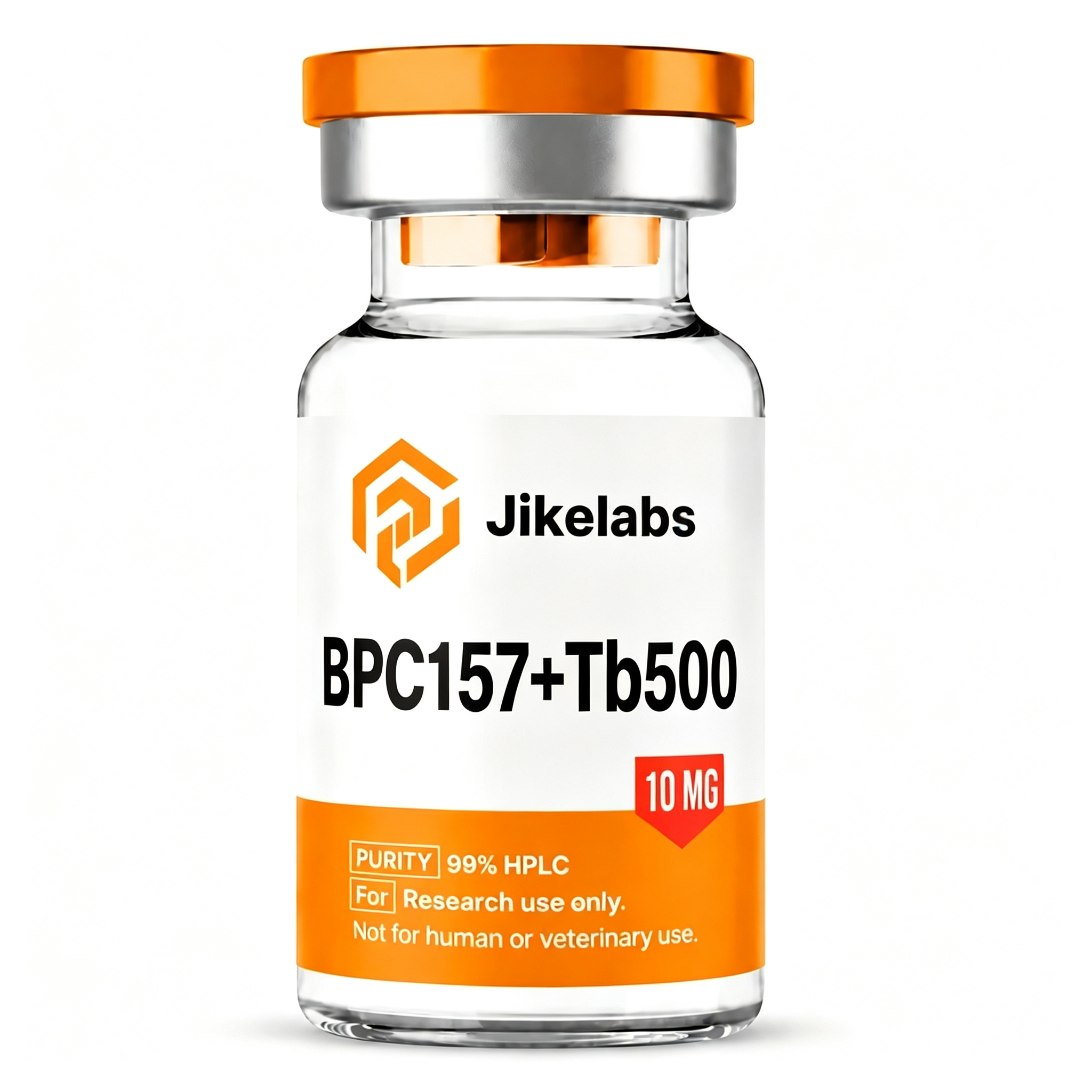
BPC157+Tb500 Blend 10MG 20MG 30MG 100MG
-
Detail
BPC-157 + TB-500 Blend 10mg
Dual-Pathway Tissue Repair Blend | Angiogenesis + Cell Migration in One Vial
BPC-157 5mg + TB-500 5mg · Fixed-Ratio Lyophilized Blend · Research Use Only
🔗 Complementary Paths
BPC-157 builds the vascular supply; TB-500 mobilizes repair cells along it — two non-overlapping repair mechanisms, one formulation.
⚖ Fixed Ratio
5mg + 5mg per vial — a consistent 1:1 ratio across every study, no separate reconstitution needed.
📚 Dual Evidence Base
Each component carries its own published literature: VEGFR2 angiogenesis (BPC-157) and actin-driven cell migration (TB-500).
🧊 Stable Lyophilized
Both peptides freeze-dried together with no fillers; water-soluble for easy reconstitution.
Product Overview
The BPC-157 + TB-500 blend pairs two of the most extensively studied tissue-repair peptides in a single fixed-ratio lyophilized vial: 5mg BPC-157 — a gastric pentadecapeptide researched for angiogenesis and cytoprotection — and 5mg TB-500 — the biologically active fragment of thymosin beta-4 researched for actin regulation and cell migration.
The rationale behind this pairing is mechanistic complementarity: BPC-157 upregulates the VEGFR2 pathway to build the blood-vessel network that healing tissue depends on, while TB-500 drives the migration of repair cells (fibroblasts, keratinocytes, endothelial cells) to the target site via actin polymerization. Rather than duplicating one pathway at double strength, the blend engages two distinct stages of the repair cascade simultaneously.
This formulation is popular with researchers studying musculoskeletal recovery, tendon and ligament models, and wound-healing workflows where both vascular supply and cell mobilization are limiting factors.
Specifications
Product Name BPC-157 + TB-500 Blend Total Net Peptide 10 mg / vial (5mg BPC-157 + 5mg TB-500) Physical Form White to off-white lyophilized powder, no fillers Solubility Water-soluble Purity ≥ 99% (by HPLC, per component) Storage Store at 2–8°C; for long-term storage, freeze and protect from light and moisture The Two Components
1. BPC-157 — 5mg (Body Protection Compound)
CAS 137525-51-0 · C₆₂H₉₈N₁₆O₂₂ · MW ≈ 1419.5 g/mol · 15 residues
A pentadecapeptide (H-Gly-Glu-Pro-Pro-Pro-Gly-Lys-Pro-Ala-Asp-Asp-Ala-Gly-Leu-Val-OH) originally identified as a partial sequence of a protein found in human gastric juice. Noted for exceptional biochemical stability. In endothelial cell cultures it was associated with VEGFR2 expression and activation of the pro-angiogenic VEGFR2-Akt-eNOS pathway; in tendon and fibroblast models it was linked to greater fibroblast outgrowth, cell survival under oxidative stress, and migration through the FAK-paxillin pathway. The vascular-infrastructure layer of the blend.
2. TB-500 — 5mg (Thymosin Beta-4 Fragment)
CAS 77591-33-4 · C₂₁₂H₃₅₀N₅₆O₇₈S · MW ≈ 4963.4 g/mol · 43 residues
A synthetic version of a 43-amino-acid segment of thymosin beta-4, a protein present in most animal cells. Corresponds to the actin-binding region: structural studies show it sequesters monomeric G-actin and regulates filament assembly. In wound models, thymosin beta-4 was associated with increased re-epithelialization and keratinocyte migration, plus anti-fibrotic activity that helps limit excessive scar formation. The cell-mobilization layer of the blend.
Two Pathways, One Repair Cascade
Stage Peptide What Happens 1. Vascularization BPC-157 New blood vessels form via VEGFR2 upregulation, delivering the oxygen and nutrients that damaged tissue needs to rebuild. 2. Cell Mobilization TB-500 Repair cells migrate to the target site through actin polymerization — using the vascular network BPC-157 supports as its delivery route. 3. Scar Modulation TB-500 Anti-fibrotic activity helps limit excessive scar formation during the healing process, favoring organized tissue over disorganized collagen. 4. Cytoprotection BPC-157 Membrane-stabilizing and cytoprotective activity documented across gastric, hepatic and vascular ischemia-reperfusion models. Note: the synergy model is mechanistically grounded in each component's individual research; no published combination study has directly tested this specific two-peptide formulation.
Research Highlights
📖 BPC-157: 2025 Systematic Review — 36 Studies
A systematic review of 36 studies found BPC-157 improved structural and biomechanical outcomes in ligament, tendon, muscle and bone injury models.
📖 Hsieh et al., 2017 (J Mol Med)
Therapeutic potential of pro-angiogenic BPC-157 is associated with VEGFR2 activation and up-regulation in vascular endothelial cell cultures.
📖 Malinda et al., 1999 (J Invest Dermatol)
Thymosin beta-4 accelerated wound healing in full-thickness wound models, with increased re-epithelialization and keratinocyte migration.
📖 Chang et al., 2011 (J Appl Physiol)
The promoting effect of BPC-157 on tendon healing involves tendon outgrowth, cell survival, and cell migration via the FAK-paxillin pathway.
Research Applications
🦴 Musculoskeletal repair models — tendon, ligament, muscle and bone injury studies. 🩹 Wound-healing research — angiogenesis, re-epithelialization and cell-migration readouts. 🧫 Comparative single-peptide vs combination studies — controlling for relative dosing across both compounds. 🔬 Angiogenesis assays (tube formation, VEGFR2 expression) paired with migration assays (scratch, transwell). ⚗️ Prefer a four-pathway formula with KPV and GHK-Cu? See our KLOW 80 blend; for a three-component formula, see GLOW 70. Reconstitution & Handling
💧 Add sterile or bacteriostatic water slowly down the side of the vial; swirl gently until fully dissolved — do not shake vigorously. 📐 Because this is a fixed-ratio blend, the reconstitution volume sets both peptide concentrations proportionally (50% BPC-157, 50% TB-500 of any given amount). 🧪 Aliquot reconstituted solution to avoid repeated freeze-thaw cycles. 🧊 Lyophilized vials: store frozen (-20°C), protected from light and moisture; reconstituted solution: refrigerate and use within your validated stability window. Quality Assurance
✔ Each component is verified individually for identity and purity — not just total mass — via lot-specific Certificate of Analysis (HPLC purity + mass-spectrometry identity confirmation).
✔ Third-party batch testing documentation available upon request.
References & Further Reading
- Hsieh MJ, et al. Therapeutic potential of pro-angiogenic BPC157 is associated with VEGFR2 activation and up-regulation. J Mol Med. 2017;95(3):323-333.
- Chang CH, et al. The promoting effect of pentadecapeptide BPC 157 on tendon healing involves tendon outgrowth, cell survival, and cell migration. J Appl Physiol. 2011;110(3):774-780.
- Malinda KM, et al. Thymosin beta4 accelerates wound healing. J Invest Dermatol. 1999;113(3):364-368.
- Xue B, et al. Structural basis of thymosin-β4/profilin exchange leading to actin filament polymerization. PNAS. 2014;111(43):E4596-E4605.
- Emerging use of BPC-157 in orthopaedic sports medicine — systematic review of 36 studies. PMC12313605. 2025.
Disclaimer: This product is intended exclusively for in-vitro laboratory research use. It is not approved for human or animal use, is not a drug, food, cosmetic, or dietary supplement, and is not intended to diagnose, treat, cure or prevent any disease. All products are supplied strictly for research purposes only. -
Customer ReviewsNo comments