
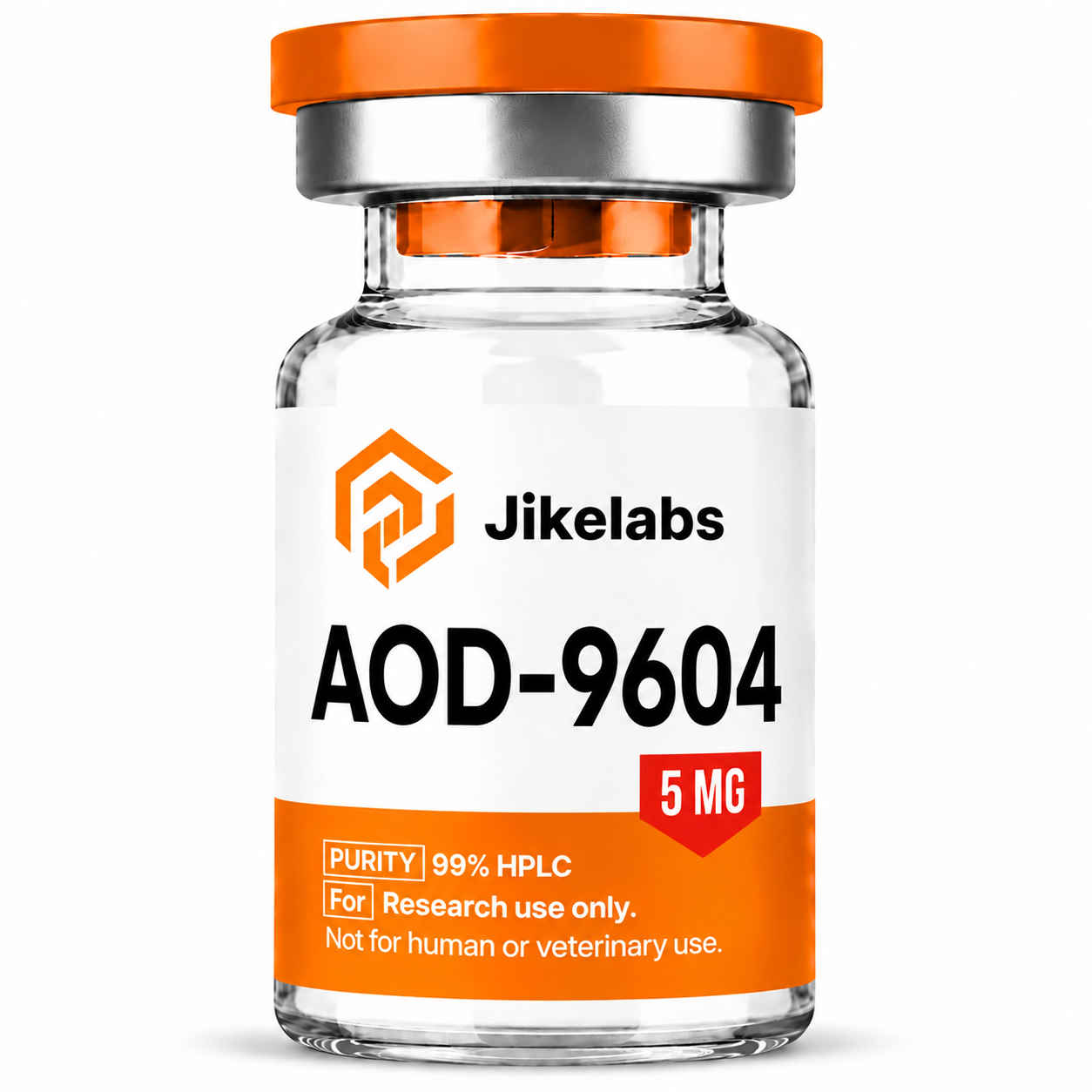
AOD9604 5MG 10MG
-
Detail
AOD-9604 5mg
Anti-Obesity Drug 9604 | The Lipolytic Fragment of Human Growth Hormone
hGH Fragment 176-191 · 16-Amino-Acid Modified Peptide · Research Use Only
🔥 Lipolysis, Isolated
Engineered to retain the fat-breakdown activity of hGH — while leaving behind its growth-promoting and glucose-disrupting effects.
⚖ Dual Lipid Action
Stimulates fat breakdown (lipolysis) while inhibiting new fat formation (lipogenesis) in adipocyte models.
📚 Human-Trial History
One of the few research peptides with actual randomized human trials — a well-documented development record.
🧊 No IGF-1 Effect
Unlike full-length hGH, AOD-9604 does not elevate IGF-1 or disrupt glucose metabolism in published studies.
Product Overview
AOD-9604 (Anti-Obesity Drug 9604) is a synthetic 16-amino-acid peptide modeled on the lipolytic region of human growth hormone (hGH). It corresponds to the C-terminal fragment of hGH — residues 176–191, also described as Tyr-hGH fragment 177–191 — with a stabilizing N-terminal tyrosine modification. It was originally developed in Australia by Dr. Frank Ng and colleagues as a targeted approach to obesity: keeping the fat-metabolizing benefits of growth hormone while discarding its unwanted anabolic and metabolic side effects.
Full-length hGH raises IGF-1 levels and can disrupt glucose metabolism — risks that made it unsuitable as an anti-obesity therapy. AOD-9604 was engineered to sidestep both problems: published animal studies showed it induces weight loss and increases lipolytic sensitivity without affecting IGF-1 or blood glucose, acting through the beta-adrenergic pathway (particularly β3-adrenergic receptors) rather than the GH receptor.
Each vial contains 5mg of high-purity AOD-9604 as a lyophilized powder, supplied for research use only.
Specifications
Product Name AOD-9604 (AOD9604) Synonyms Anti-Obesity Drug 9604 · Tyr-hGH Fragment 177-191 · hGH Fragment 176-191 CAS Number 221231-10-3 Amino Acid Sequence Tyr-Leu-Arg-Ile-Val-Gln-Cys-Arg-Ser-Val-Glu-Gly-Ser-Cys-Gly-Phe (16 residues) Molecular Formula C78H123N23O23S2 Molecular Weight 1815.1 g/mol Net Content 5 mg / vial Appearance White to off-white lyophilized powder Purity ≥ 99% (by HPLC) Solubility Soluble in aqueous buffer; slightly soluble in DMSO Storage Store at 2–8°C; for long-term storage, freeze and protect from light and moisture Why a Fragment? AOD-9604 vs Full-Length hGH
Aspect Full-Length hGH AOD-9604 Lipolytic Activity Present Retained (core design goal) IGF-1 Elevation Yes — growth-promoting effects No IGF-1 effect in published studies Glucose Metabolism Can induce hyperglycemia / insulin resistance No disruption reported in published studies Receptor Pathway GH receptor Beta-adrenergic pathway (β3-AR), not the GH receptor Mechanism of Action
🔥 Lipolysis stimulation — promotes the breakdown of stored fat in adipocytes, increasing lipolytic sensitivity during chronic exposure (Ng et al., 2001). 🚫 Lipogenesis inhibition — suppresses the formation of new fat, working on both sides of the lipid balance. 🧬 β3-Adrenergic engagement — mechanistic work points to interaction with the beta-adrenergic pathway, particularly β3-adrenergic receptors, rather than the growth-hormone receptor. 🦴 Emerging cartilage research — recent literature includes AOD-9604 among peptides studied in cartilage-regeneration and osteoarthritis research contexts. Research Highlights & Evidence History
📖 Ng et al., 2001 — Foundational Animal Study
Both hGH and its lipolytic fragment AOD-9604 induced weight loss and increased lipolytic sensitivity following chronic treatment in obese mice, including β3-adrenergic-receptor knock-out models — establishing the fragment's lipid-metabolism profile.
📖 12-Week Randomized Clinical Trial (as cited in Misra & Miller, 2013)
Subjects receiving AOD-9604 (1 mg/day) lost an average of 2.6 kg versus 0.8 kg in the placebo group — evidence of human-level activity, though modest in magnitude.
📋 Honest Evidence Status
AOD-9604 progressed through multiple human trials with a good safety and tolerability record, but its Phase 2b obesity trial did not meet its primary endpoint, and it holds no approved indication. We present this development history transparently so researchers can evaluate the compound's evidence base accurately. (Additionally, the U.S. FDA has placed peptides such as AOD-9604 in Category 2 bulk-substance review for compounding contexts — regulatory status varies by jurisdiction.)
Research Applications
🧫 Adipocyte biology — lipolysis / lipogenesis pathway assays and lipid-metabolism readouts. ⚖️ Obesity and body-composition research models, including diet-induced obesity studies. 🧬 Beta-adrenergic signaling research (β3-AR engagement studies). 🦴 Emerging cartilage / osteoarthritis research contexts referenced in recent literature. Reconstitution & Handling
💧 Add sterile or bacteriostatic water slowly down the side of the vial; swirl gently until fully dissolved — do not shake vigorously. 🧪 Aliquot reconstituted solution to avoid repeated freeze-thaw cycles. 🧊 Lyophilized powder: store frozen (-20°C), protected from light and moisture; reconstituted solution: refrigerate and use within your validated stability window. ⚖️ Handle with aseptic technique and appropriate PPE per your laboratory SOP. Quality Assurance
✔ Lot-specific Certificate of Analysis: HPLC purity confirmation + mass-spectrometry identity verification.
✔ Third-party batch testing documentation available upon request.
References & Further Reading
- Ng FM, Jarrott B, Chen WJ, et al. The effects of human GH and its lipolytic fragment (AOD9604) on lipid metabolism following chronic treatment in obese mice and β3-AR knock-out mice. Int J Obes. 2001. (PubMed: 11713213)
- Misra M, Miller KK. Obesity pharmacotherapy: current perspectives and future directions. PMC3584306. 2013. (12-week randomized clinical trial citation)
- Moré MI, et al. Safety and metabolism of AOD9604, a novel nutraceutical. J Obes Eat Disord. 2014. (GRAS-status reference)
- Peptides for targeting chondrogenic induction and cartilage regeneration in osteoarthritis. SAGE Journals. 2026. (cartilage-research context)
- AOD9604 — Wikipedia / PubChem CID 71300630 (sequence, formula, molecular weight reference).
Disclaimer: This product is intended exclusively for in-vitro laboratory research use. It is not approved for human or animal use, is not a drug, food, cosmetic, or dietary supplement, and is not intended to diagnose, treat, cure or prevent any disease. Weight-loss findings cited above are from published studies and do not constitute efficacy claims for any commercial product. All products are supplied strictly for research purposes only. -
Customer ReviewsNo comments